
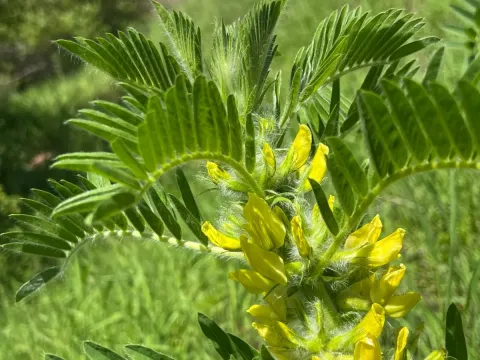
Astragalus sieversianus
Astragalus sieversianus
Astragalus sieversianus is a perennial herb belonging to the Fabaceae family, recognized for its exceptional resilience in arid and semi-arid environments. Naturally occurring in mountainous steppes, this species is increasingly studied for its agricultural potential as a robust forage and soil-stabilizing crop.
What the section contains
Astragalus sieversianus
Sowing should ideally occur in early spring, once the soil has sufficiently thawed and warmed. Due to the hard seed coat characteristic of many Astragalus species, scarification is a prerequisite to ensure uniform germination and to break seed dormancy before planting.
The optimal seeding density depends on the target purpose; for seed production, wider row spacing is recommended to reduce intraspecific competition. A planting depth of 2 to 3 cm is generally sufficient, provided that the soil maintains adequate contact and moisture during the initial emergence phase.
In the first year of establishment, Astragalus sieversianus allocates most of its energy to developing a deep, strong taproot system. During this period, farmers must prioritize weed management, as young seedlings are sensitive to competition from fast-growing weeds and invasive plant species.
Site preparation is critical and should involve clearing the land of perennial weeds and incorporating phosphorus-based fertilizers to promote vigorous root development. Proper inoculation with site-specific nitrogen-fixing rhizobia can significantly improve the crop's establishment and subsequent growth rates.
This crop thrives in well-drained soils, ranging from sandy loams to rocky substrates, and is highly intolerant of waterlogged conditions. It prefers neutral to slightly alkaline soil pH, typical of the arid environments where the plant is native and naturally adapted.
Astragalus sieversianus is a classic xerophyte, demonstrating remarkable drought tolerance throughout its life cycle. It is well-suited for regions with significant seasonal temperature fluctuations, as it can withstand extreme winter frosts without compromising its structural integrity.
Sunlight exposure is a limiting factor for biomass production; therefore, the crop must be planted in open, unshaded areas to achieve maximum photosynthetic efficiency. While it can survive in nutrient-poor soils, higher yields are obtained when essential minerals are available.
The plant demonstrates high resource efficiency, making it an excellent candidate for low-input agricultural systems. Its deep root system also plays a secondary role in soil aeration and improvement of soil structure, which benefits subsequent crop rotations in the field.
Management of the crop involves periodic soil loosening, particularly in the inter-row spaces, to enhance water infiltration and gas exchange. During extreme dry spells, the crop remains dormant and resumes growth immediately upon the arrival of moisture, showcasing its adaptive survival strategy.
Common phytopathological threats to Astragalus sieversianus include fungal diseases such as powdery mildew and rust, which often manifest during periods of high humidity. Maintaining proper plant density and ensuring good airflow within the canopy are the primary cultural controls for these diseases.
Insect pests include various beetle species, particularly weevils that target reproductive organs and developing seeds, posing a risk to seed production yields. Monitoring for these pests during the flowering phase is essential for successful seed harvesting and overall crop vigor.
Integrated Pest Management (IPM) strategies are recommended to mitigate threats while minimizing the impact on the local ecosystem. This includes the use of biological control agents and carefully timed applications of insecticides only when economic thresholds are exceeded.
Preventative measures are highly effective; these include using clean, certified seeds and maintaining clean borders around the fields. Field monitoring should be conducted bi-weekly during the growing season to detect early signs of infestation and prevent large-scale outbreaks.
The crop's inherent chemical composition, which includes various secondary metabolites, provides a degree of natural protection against several generalist herbivores. Despite this, management must remain vigilant to protect the plant during its most vulnerable seedling stages.