
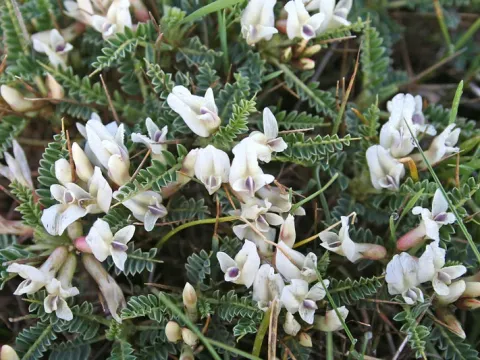
Astragalus sirinicus
Astragalus sirinicus
Astragalus sirinicus is a perennial herbaceous plant belonging to the Fabaceae (legume) family. This species is highly valued for its adaptation to specific harsh environmental conditions where other crops fail to thrive.
What the section contains
Astragalus sirinicus
The plant thrives in well-drained, lime-rich, or rocky soils. Proper aeration is crucial for the root system, as this species cannot tolerate waterlogging, which often leads to root collar decay and sudden plant death.
Environmental requirements include a temperate climate with high exposure to sunlight. Its inherent drought tolerance makes it a resilient candidate for cultivation in arid or semi-arid regions with irregular precipitation patterns.
Regarding agrotechnology, the sowing depth must be carefully calibrated to ensure uniform emergence. Since the plant has a slow initial growth rate, it requires clean fields free from competitive weed species during the establishment phase.
The agricultural potential of Astragalus sirinicus is centered on its nitrogen-fixing ability and its role in soil conservation. It is an excellent choice for reclamation of degraded landscapes and improving soil structure through its deep taproot system.
Fungal diseases are the primary threat, particularly in regions with high atmospheric humidity or poor soil drainage. Pathogens attacking the root and leaf systems represent a significant challenge for healthy biomass development.
Insect pests, including aphids and various seed-feeding weevils, can severely limit yield potential. Integrated Pest Management (IPM) strategies, including the use of pheromone traps and selective pesticides, are recommended for large-scale production.
Competition from fast-growing weeds is the most critical threat in the seedling stage. Mechanical hoeing or targeted application of herbicides is essential to support the slow-developing seedlings of the plant.
Soil-borne pathogens like Fusarium can be detrimental if crop rotation is neglected. Maintaining a proper rotation cycle of at least 4 to 5 years is necessary to keep the soil healthy for perennial leguminous crops.
Regular visual inspections are necessary to identify stress symptoms early. Proper field management, including the removal of dead or decaying plant material, helps in reducing the inoculum density of common agricultural pests.