
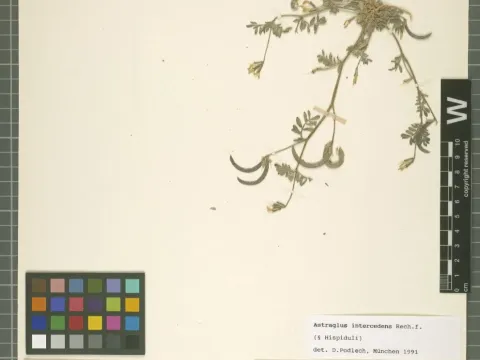
Astragalus intercedens
Astragalus intercedens
Astragalus intercedens is a perennial herbaceous plant belonging to the Fabaceae family, recognized for its potential as a valuable forage and soil-improving crop.
What the section contains
Astragalus intercedens
Sowing should ideally take place in early spring, once the soil has warmed up and contains sufficient moisture for consistent germination and early development.
The optimal sowing depth is 1 to 2 cm; planting deeper significantly reduces the emergence rate due to the limited energy reserves in the seeds.
Prior to planting, seed scarification is often recommended to overcome dormancy and improve the overall field emergence percentage.
Successful establishment relies on uniform seed distribution and careful management of seedbed conditions to ensure proper soil-to-seed contact.
This species is highly drought-tolerant, utilizing a deep taproot system to access water and minerals from lower soil horizons during dry spells.
It prefers well-drained, fertile soils with a neutral pH, and it does not thrive in waterlogged environments or areas with poor drainage.
Full sunlight is essential for the healthy growth of Astragalus intercedens; shading by tall weeds or trees will suppress its vigor.
The plant is adapted to temperate climates, displaying significant cold hardiness and the ability to overwinter successfully in various regions.
Adequate ventilation is important, especially in regions with high humidity, to prevent the development of fungal pathogens on the foliage.
The productivity of Astragalus intercedens is highly dependent on effective nodulation and the presence of symbiotic nitrogen-fixing bacteria in the soil.
Under managed conditions, the crop produces high-quality forage that is rich in crude protein, making it an excellent addition to livestock feed ratios.
Sustainable yields can be maintained through periodic phosphorus and potassium fertilization, which strengthens the plant and promotes rapid regrowth.
The ability to produce multiple cuts within a single growing season increases its economic value for forage producers and livestock farmers.
Proper management of the cutting frequency ensures that the plant retains enough energy reserves in the root system for healthy regrowth.
Fungal diseases, including powdery mildew and rust, are the primary biotic threats, especially during seasons with prolonged wet conditions.
Various insects, such as weevils, can cause damage to the leaves and developing roots, leading to reduced overall biomass production.
Weed competition is the most significant challenge during the seedling stage, requiring vigilant weed control strategies such as mechanical cultivation.
Seed-eating pests can significantly decrease harvestable yields, requiring careful monitoring and potential intervention before the seeds mature.
- Regular field scouting for pests.
- Implementation of crop rotation.
- Use of certified, high-quality seeds.
Harvesting for forage should occur during the full flowering stage, which represents the optimal balance between biomass volume and nutritional quality.
It is crucial to adjust mowing equipment to leave sufficient stubble to protect the crown of the plant and facilitate rapid recovery.
When harvesting for seed, timing is critical; the crop should be mowed when the pods reach maturity but before they begin to shatter in the field.
Post-harvest handling must prioritize gentle drying to prevent the loss of leaves, which are the most nutrient-dense part of the harvested material.
Proper seed storage requires drying to a moisture content below 14% to maintain long-term viability and prevent fungal growth in storage bins.