
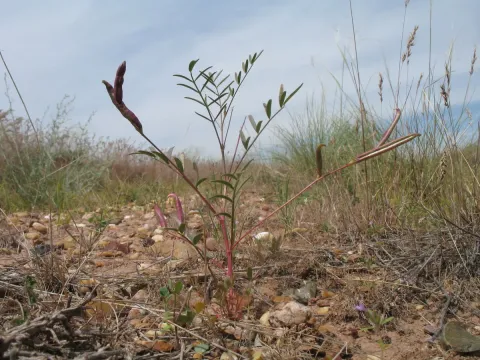
Astragalus campylorhynchus
Astragalus campylorhynchus
Astragalus campylorhynchus is a heat-loving plant; therefore, sowing is recommended in the spring when the soil at the seed depth reaches 10–12 degrees Celsius.
What the section contains
Astragalus campylorhynchus
The optimal timing for fieldwork typically falls between the second half of April and early May, depending on the specific climatic region.
The seeds of this crop have a hard coat, so scarification is often performed before sowing to improve germination rates and accelerate emergence.
The planting depth ranges from 1.5 to 3 centimeters, ensuring optimal soil moisture contact for successful and uniform seedling emergence.
The seeding rate is calculated based on the purity and germination of the seed material, usually ranging from 10 to 15 kg per hectare for drill sowing.
This crop belongs to the Fabaceae family and is known for its high resistance to arid conditions, making it a promising candidate for dry regions.
The plant prefers light sandy or loamy soils with good aeration, as it does not tolerate waterlogging or stagnant water around the root system.
Astragalus campylorhynchus is light-demanding and performs poorly in shaded areas, so it should be placed in open, sunny locations for maximum growth.
The optimal pH range for successful development is from neutral to slightly alkaline; the crop is also capable of growing in saline soils.
Throughout the growing season, the plant adapts well to temperature fluctuations, although severe frosts during the active flowering phase can reduce productivity.
The agricultural use of Astragalus campylorhynchus is primarily aimed at producing high-quality forage and hay, which are rich in protein.
Green mass yield depends on soil moisture and fertility levels, averaging between 10 and 20 tons per hectare per single harvest.
Due to its nitrogen-fixing ability, this species improves soil fertility by accumulating significant amounts of organic nitrogen in the root zone.
When used as pasture, the crop shows good regrowth potential, allowing it to recover quickly after livestock grazing throughout the season.
To increase seed production, it is important to ensure pollinator activity, as cross-pollination is a key factor for successful fruit set.
The main pests of this crop include weevils and various species of aphids, which damage reproductive organs and reduce the overall seed yield.
Under high humidity, plants can be affected by powdery mildew or rust, requiring proper stand density and field ventilation to mitigate these risks.
Root rot poses a danger in heavy soils with poor drainage, which can lead to significant plant loss during the spring season.
Pest management in commercial fields typically involves preventive measures such as crop rotation and the use of resistant varieties.
It is important to control weed growth in the fields, as the crop develops slowly during its first year and is sensitive to competition for light.
Harvesting for hay should be conducted at the onset of flowering when nutrient concentrations in the aerial parts are at their maximum.
When harvesting seeds, wait for the pods to turn brown; however, it is critical to prevent over-drying to avoid pod shattering and seed loss during combining.
After mowing, it is recommended to dry the swaths quickly to maintain the high nutritional value of the leaves and prevent leaf loss.
Seed harvesting often involves either direct or two-stage harvesting methods, depending on weather conditions and the uniformity of pod maturity.
Stored biomass must be kept in low-humidity conditions to prevent mold development and preserve the nutritional quality of the forage.