
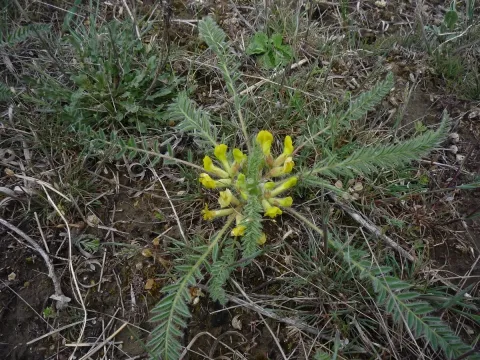
Astragalus buchtormensis
Astragalus buchtormensis
Sowing of Astragalus buchtormensis is typically carried out in early spring when soil temperatures reach 6–8 degrees Celsius, ensuring uniform seedling emergence. Early spring is optimal due to the crop's moisture requirements during the initial stages of development.
What the section contains
Astragalus buchtormensis
Scarification of seeds is highly recommended to improve germination, as the hard seed coat can otherwise delay emergence. The seeding method involves rows with spacing between 15 and 30 centimeters, depending on whether the crop is intended for hay or seed production.
The planting depth should be between 1 and 2 centimeters, adjusted according to soil texture and moisture levels. In heavier soils, seeds are planted shallower, while in lighter soils, they are sown deeper to prevent drying out before germination.
Seeding rates vary based on seed viability and planting method, typically ranging from 8 to 12 kilograms per hectare. After sowing, it is crucial to use a roller to ensure firm soil contact with the seeds, which significantly improves the success rate of crop establishment.
The plant exhibits slow growth during its first year, making effective weed management essential during this period to ensure the development of a robust root system and to prevent competition from invasive species.
Astragalus buchtormensis is a drought-tolerant plant, making it a valuable resource for arid and semi-arid regions. It is well-adapted to harsh climatic conditions and extreme temperature fluctuations, reflecting its origin as a mountain and steppe flora.
Regarding soil conditions, the plant prefers fertile, well-aerated soils with a neutral or slightly alkaline pH. Waterlogged fields or areas with high water tables are completely unsuitable for the cultivation of this specific legume species.
The plant possesses a powerful taproot system capable of reaching deep soil horizons to access moisture and nutrients. This physiological trait allows the crop to maintain productivity even during periods of significant rainfall deficits.
It responds well to phosphorus and potassium fertilization, which promote root system development and enhance winter hardiness. Nitrogen fertilizers are applied only in small doses as a starter, as the plant effectively fixes atmospheric nitrogen through symbiotic relationships with nodule bacteria.
Light exposure is a critical factor for successful growth; the plant is photophilous, and shaded conditions significantly reduce green mass productivity. Selecting open, sun-exposed fields is a prerequisite for achieving optimal yields.
Productivity typically reaches its peak starting from the second year as the stand fully matures. Under favorable conditions, the green mass yield can reach 15 to 25 tons per hectare with one or two harvests per season.
Hay yield is highly dependent on irrigation management and soil fertility. On average, farmers can expect 4 to 7 tons of hay per hectare with proper field management and minimal weed pressure.
Seed production yields are variable and depend largely on weather conditions and pollinator activity, typically ranging from 150 to 300 kilograms per hectare depending on the year.
To maximize yields, it is vital to harvest at the optimal developmental stage, avoiding stem lignification. Timely cutting encourages faster regrowth (aftermath) and may allow for a secondary, albeit smaller, harvest.
The crop maintains high productivity for 5 to 8 years, making it an economically attractive component for long-term crop rotation cycles and the establishment of perennial grazing pastures.
Astragalus buchtormensis is generally resistant to most common forage legume diseases; however, high humidity levels can trigger powdery mildew outbreaks. Prevention involves maintaining appropriate seeding densities to avoid crop crowding.
The main pests are various species of weevils that damage seeds and reproductive organs. To control pest populations, biological or chemical protection measures are implemented during the budding phase of the plant.
Root system diseases caused by fungal infections are common in waterlogged soils, leading to thinning of the crop stand. Using high-quality treated seeds helps reduce the risk of infection during the early stages of development.
Nematodes can negatively impact root development, reducing the plant's ability to fix nitrogen and absorb nutrients. Integrating crop rotation helps limit the buildup of soil-borne pathogens in the field.
- Following crop rotation practices to prevent pest accumulation.
- Using high-quality, treated seed materials.
- Monitoring stands during the budding and flowering phases.
- Regularly removing weeds that serve as intermediate hosts for pests.
Hay harvesting is conducted at the beginning of the flowering phase, as nutrient content in the green mass reaches its peak during this period. This ensures the best nutritional quality for livestock feed.
During hay processing, rapid drying is essential to preserve carotene and vitamin content. Turning the swaths allows for even drying, preventing leaf shattering and loss, which are the most protein-rich parts of the plant.
As seeds ripen unevenly, harvesting seed production areas is usually done when approximately 70–80% of the pods turn brown. Desiccation can be employed to unify the ripening process and facilitate easier threshing.
Threshing is performed with combine harvesters equipped with adjusted settings to minimize damage to the tough-coated seeds. Cleaning the seeds of impurities and ensuring standard moisture levels are mandatory steps before long-term storage.
Post-harvest residues of Astragalus provide valuable organic matter that improves soil structure and nitrogen content. Incorporating these residues into the soil helps boost humus levels in the upper fertile layer.