
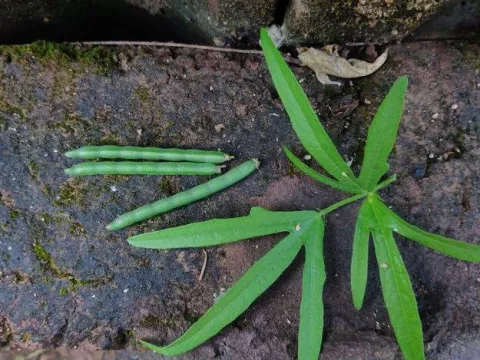
Moth bean
Phaseolus aconitifolius
Moth bean (Vigna aconitifolia), belonging to the Fabaceae family, is a highly heat-tolerant legume crop primarily grown in arid and semi-arid regions. Successful planting requires well-warmed soil, typically above 18°C.
What the section contains
Moth bean
In traditional cultivation areas, sowing coincides with the onset of monsoon rains, whereas in temperate zones, it should be timed to avoid any frost risk, usually in late spring. The plant requires a stable, warm environment for germination.
Seeds are sown at a depth of 3–5 cm. A proper seeding rate is essential; typically, 10–15 kg of seeds per hectare is sufficient to achieve optimal plant density for grain production, while higher rates are used for forage.
Row spacing is generally maintained at 30–45 cm. This allows for sufficient space for the sprawling habit of the plant, which often covers the soil surface effectively once established.
The plant exhibits rapid initial growth under favorable moisture conditions, which helps in suppressing weed competition during the early stages of development.
The defining characteristic of Moth bean is its superior drought tolerance compared to other grain legumes. It thrives in high-temperature environments that would inhibit the growth of more sensitive crops.
Soil requirements are relatively flexible; however, it prefers well-drained sandy or loamy soils. The crop is extremely sensitive to waterlogging and poor soil aeration, which can lead to rapid root decay.
High solar radiation is crucial for the development of Moth bean. It is a photophilic plant that requires full sunlight to optimize its photosynthetic activity and nitrogen fixation processes.
Moth bean is capable of fixing atmospheric nitrogen through symbiosis with Rhizobium bacteria, reducing the need for synthetic nitrogen fertilizers and making it an excellent component for sustainable crop rotations.
Temperature range of 25–35°C is ideal for vegetative growth. While it is remarkably hardy against heat, it is sensitive to temperatures below 10°C, which can cause physiological stress and stop growth entirely.
The grain yield of Moth bean typically ranges from 0.5 to 1.2 tonnes per hectare under rain-fed conditions. Yield variation is largely determined by rainfall distribution during the flowering and pod-filling stages.
With supplemental irrigation or improved agronomic management, including micro-nutrient application, yields can potentially reach 2 tonnes per hectare in experimental or highly favorable field conditions.
Beyond grain production, the plant is highly valued for its green biomass. It produces high-quality forage, with dry hay yields often reaching 3–4 tonnes per hectare, making it vital for livestock systems in dry areas.
The crop has an indeterminate growth habit, meaning that flowering and pod maturation happen over an extended period, necessitating careful planning for the harvest to minimize potential grain loss.
The seeds are a dense source of protein (approx. 23%) and dietary minerals, maintaining a steady market demand for human consumption in South Asia and global specialty markets.
Although robust, Moth bean can be susceptible to powdery mildew and bacterial leaf spots, especially during high humidity periods. Proper field ventilation is a primary management tool.
Pest pressures include aphids and whiteflies, which are not only direct feeders but also vectors for mosaic viruses that can significantly reduce crop productivity if not monitored closely.
Storage pests, particularly various species of bruchids (pulse beetles), represent a major threat to grain quality post-harvest. Effective storage management is required to prevent significant stock loss.
Root rots may occur if the crop is planted in heavy, poorly drained soils. Maintaining proper field drainage and practicing good crop rotation with non-legumes is essential to mitigate these soil-borne threats.
Integrated pest management strategies focusing on resistant varieties and timely scouting are preferred over prophylactic chemical applications to maintain the ecological balance in agricultural fields.
Harvesting is initiated when the majority of the pods turn brown and leaves begin to senesce. Delaying harvest leads to significant pod shattering and subsequent loss of seeds in the field.
The traditional harvest involves cutting the plants and allowing them to dry in windrows for a few days, followed by mechanical threshing. This helps achieve uniform seed moisture content.
Modern direct combining is possible but requires precise machine settings to avoid excessive seed splitting and damage, as the seeds are relatively delicate when fully dry.
Post-harvest processing involves thorough cleaning and drying of the seeds. Maintaining a moisture level below 14% is critical for safe storage to prevent fungal contamination and beetle infestations.
The haulm (crop residue) is rich in nutrients and is often incorporated back into the soil, providing organic matter and residual nitrogen to improve the fertility of the soil for the subsequent planting season.