
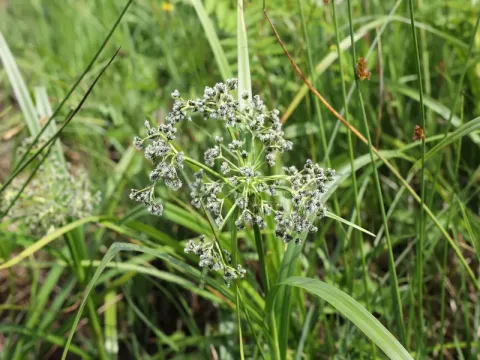
Woodland bulrush
Scirpus sylvaticus
Woodland bulrush (Scirpus sylvaticus) is a perennial herbaceous plant belonging to the Cyperaceae family. It is typically propagated through the division of rhizomes, which ensures rapid establishment in wet soil conditions suitable for its growth.
What the section contains
Woodland bulrush
Planting is best performed in early spring, when the soil is moisture-rich following the winter season. Seeds can be sown at a shallow depth of 1-2 cm, as they require sufficient light and constant moisture to germinate and develop into viable seedlings.
High-density planting should be managed to ensure adequate airflow, preventing the development of fungal infections in the humid microclimate of the stand. Proper spacing promotes robust growth and root development in the first season.
For commercial cultivation, sites such as riparian buffers, floodplains, or areas with high water tables are ideal. The plant is highly resilient and thrives in saturated soils where traditional crops would fail.
Agronomic maintenance in the first year requires weed management to protect young plants. Once the stand is established and the sod layer is thick, the bulrush becomes highly competitive and naturally suppresses most unwanted vegetation.
The plant requires fertile, heavy, loamy, or peaty soils with constant moisture levels. As a hydrophyte, woodland bulrush depends on high water availability throughout the growing season to reach its full productive potential.
It exhibits excellent winter hardiness, allowing it to survive in cold climates without special cover. The species thrives in a pH range from slightly acidic to neutral, making it adaptable to various wetland environments.
Sunlight is a crucial factor for biomass production. While woodland bulrush can tolerate partial shade, it achieves the highest growth rates in open areas where photosynthetic activity is not restricted.
This species is highly valued for its role in phytoremediation. It effectively removes nitrates, phosphates, and heavy metals from soil and water, making it a critical asset in ecological engineering projects.
The agronomy of this crop focuses on hydraulic management. Maintaining a steady water regime is more important than applying synthetic fertilizers, as the plant is well-adapted to nutrient-rich environments.
The yield of green biomass can reach significant levels, particularly on lowland sites enriched with organic matter. While primarily a non-food crop, it provides substantial volume for industrial processing or soil stabilization.
Its use as livestock fodder is limited to cases where it is harvested young and supplemented with other high-protein grasses. The forage value is relatively low compared to traditional agricultural grains.
The most important yield metric for woodland bulrush is its biological filtration capacity. In managed wetlands, the annual removal of biomass is essential to sustain the plant's nutrient-absorption efficiency.
Harvesting stimulates the plant to produce new shoots, maintaining a healthy, dense sod layer. Productivity typically peaks during the third or fourth year after planting as the rhizome system fully matures.
In landscaping, the crop provides value through soil erosion control. By binding the soil with its dense root network, it prevents damage to stream banks and ensures the integrity of hydraulic infrastructure.
Woodland bulrush is generally resistant to most pests and diseases. Its tissues contain secondary metabolites and silica, which act as a natural defense against many insects and pathogens common to other plants.
In extremely humid conditions, rust fungi may occur. However, these infections are usually localized and do not cause significant economic loss unless the plantation is neglected for several seasons.
The primary threat to the crop is prolonged drought, which can lead to the degradation of the root system and the decline of the stand. Fire is also a major risk, as it destroys the growing points of the rhizomes.
Competition from aggressive woody shrubs can threaten a bulrush colony. Regular site monitoring is necessary to ensure the stand remains pure and productive without interference from opportunistic trees.
Disease management is primarily prophylactic. By ensuring proper water circulation and avoiding water stagnation in warm weather, growers can minimize any potential risks to the plant's health.
Harvesting should be completed in late summer, before the seeds mature and drop. This timing maximizes the quality of the biomass and prevents the plant from spreading uncontrollably beyond the intended area.
Specialized machinery designed for soft, wet ground is recommended for harvesting. A cutting height of at least 10 cm must be maintained to avoid damaging the crown and to facilitate rapid regrowth the following spring.
Once harvested, the material should be dried effectively on raised platforms. Well-dried bulrush is highly durable and resistant to rot, making it a useful resource for secondary agricultural applications.
Harvesting is an essential agro-ecological practice. Removing the biomass prevents the recycling of absorbed pollutants back into the water, ensuring the purification cycle remains active and effective.
Equipment operation must be handled carefully to prevent deep rutting or soil compaction, which could restrict root oxygenation and negatively affect the long-term vitality of the woodland bulrush stand.