

Reference · Crops
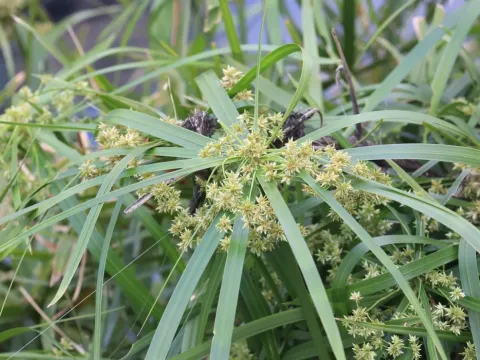
Yellow nutsedge
Cyperus
Cyperus esculentus, commonly referred to as chufa or tiger nut, is a heat-loving crop that requires well-warmed soil for optimal germination and early growth development.
10
items
What the section contains
 Nut grass
Cyperus rotundus L.
19 products
Nut grass
Cyperus rotundus L.
19 products
 Annual sedge
Cyperus compressus L.
Annual sedge
Cyperus compressus L.
 Black-seeded flatsedge
Cyperus melanospermus (Nees) J. V. Suringar
Black-seeded flatsedge
Cyperus melanospermus (Nees) J. V. Suringar
 Chufa
Cyperus esculentus L.
Chufa
Cyperus esculentus L.
 Cyperus monophyllus
 Vahl
Cyperus monophyllus
Cyperus monophyllus Vahl
 Nile papyrus
Cyperus papyrus L.
Nile papyrus
Cyperus papyrus L.
 Rice flatsedge
Cyperus iria L.
Rice flatsedge
Cyperus iria L.
 Spreading Cyperus
Cyperus diffusus Vahl
Spreading Cyperus
Cyperus diffusus Vahl
 Umbrella papyrus
Cyperus alternifolius L.
Umbrella papyrus
Cyperus alternifolius L.
 Yellow flatsedge
Cyperus flavidus Retz.
Yellow flatsedge
Cyperus flavidus Retz.
Marketplace
Products in this section · 12


Griñfort CF 40, EC (Halisulfop-p-tefuryl, 40 g/l)
Nanjing Essence Fine-Chemical Co.
Herbicides
0
0
1 offer
1.58 €per gram
Buy

Erru 120 g/L, herbicide
F.A.GAN Chemical Manufacturers Ltd. Israel, member
Herbicides
0
0
6 offers
3.13 €per 1 l
Buy

Yellow nutsedge
Planting is typically performed in late spring once the threat of frost has passed and soil temperatures have reached approximately 15–18 °C. Pre-soaking tubers in water for 48 hours is highly recommended to improve the uniformity of emergence.
The planting method involves placing 3–4 tubers in clusters, spaced 20 cm apart within rows, with an inter-row spacing of 40–50 cm to ensure adequate space for tuber expansion.
As a member of the Cyperaceae family, the plant propagates through an extensive network of underground rhizomes that produce edible tubers at their tips.
Choosing a location with full sun exposure is vital, as the crop requires significant solar energy to drive the metabolic processes necessary for the formation of oil-rich tubers.
Chufa thrives in sandy or light loamy soils that possess excellent drainage properties, as heavy or waterlogged soils inhibit tuber development and increase the risk of decay.
The plant is sensitive to temperature fluctuations and performs best in regions where summer temperatures consistently remain between 20 °C and 25 °C throughout the growing season.
Moisture management is essential; while the crop is relatively drought-tolerant, consistent soil moisture during the peak tuber-filling stage is required for maximizing yield.
Nutrient management should focus on a balanced application of organic fertilizers; excessive nitrogen can lead to exuberant leaf growth at the expense of underground tuber production.
Controlling weed pressure is a critical agronomic requirement during the first few weeks after emergence, as the plant is a poor competitor against aggressive annual weeds.
Yield potential of Cyperus esculentus varies significantly based on environmental conditions and site-specific management practices, often ranging from 5 to 10 tonnes per hectare.
The total yield is determined by the number of tubers produced per plant, their individual weight, and the length of the growing season available for tuber maturation.
The nutritional value, particularly the high oil and fiber content, makes the tubers a highly prized commodity for both food processing and dietary supplement industries.
Effective moisture regulation during the late summer months is the most influential factor in achieving uniform tuber size and high commercial quality.
Marketable yield depends heavily on post-harvest cleaning and sorting efficiency to ensure the absence of soil particles and debris from the final product batch.
The most significant threat to chufa production is the incidence of root rot and tuber pathogens, which are typically exacerbated by poorly drained soils or high humidity levels.
Insect pests, including wireworms and soil-dwelling larvae, can damage the outer layer of the tubers, making them susceptible to fungal infections during storage.
- Rust diseases affecting the foliage in humid climates.
- Infestation by aphids during stress-related growth phases.
- Damage from soil insects affecting root system integrity.
- Development of mold if storage moisture content is too high.
Integrated pest management, including crop rotation and proper site selection, is necessary to mitigate the risks posed by soil-borne diseases and pests.
Regular monitoring of field conditions allows growers to respond quickly to signs of infestation, ensuring that chemical or mechanical controls are applied appropriately.
Harvesting usually occurs in late autumn when the foliage begins to senescence, indicating that the tubers have reached peak maturity and nutrient density.
The extraction process requires loosening the soil mechanically to lift the plants, followed by careful separation of the tubers from the rhizome structures.
Post-harvest treatment involves thorough washing to remove adhering soil, followed by immediate drying in a shaded, well-ventilated area to reduce moisture content.
Precise timing is essential to avoid exposure to severe frost, which can damage the skin of the tubers and negatively impact their viability and storage life.
Properly cured tubers should be stored in breathable containers in a cool, dry environment to maintain quality and prevent spoilage for an extended shelf life.