
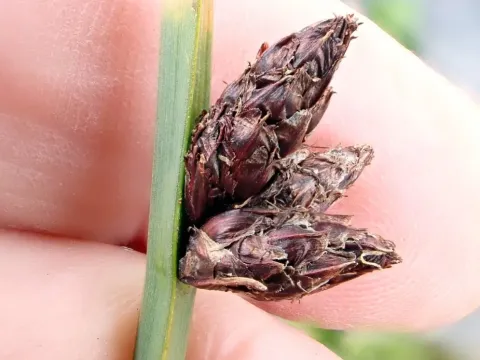
Common threesquare
Schoenoplectus pungens
Propagation of common threesquare is primarily achieved through rhizome division, which allows the plants to establish themselves quickly in new environments. Planting material is placed during early spring when soil temperatures begin to rise and water levels stabilize.
What the section contains
Common threesquare
Seed propagation is less common due to strict germination requirements, including moist substrates and specific temperature fluctuations. Seeds should be sown on the surface without deep burial, ensuring high humidity throughout the entire germination phase.
The ideal planting depth for rhizomes ranges from 10 to 30 centimeters, enabling the plant to adapt to water depth and develop a robust root system. Protecting young shoots from current-induced erosion during the first few weeks is crucial for establishment.
Planting density depends on the objective: for shoreline stabilization, 4–6 plants per square meter are sufficient, while for phytoremediation purposes, density can be increased to 10–12 specimens to accelerate water purification processes.
Once established, the common threesquare shows aggressive growth habits, independently expanding its range via creeping rhizomes, which significantly reduces the need for long-term maintenance and supplementary planting.
Common threesquare belongs to the Cyperaceae family and prefers shallow waters of rivers, lakes, and marshy landscapes. The plant exhibits high salt tolerance, allowing it to thrive in brackish environments where other species might fail.
The species is light-demanding and requires open, sun-exposed areas to maximize photosynthesis and ensure dense growth. Excessive shading negatively impacts shoot density and reduces the rate of colony expansion along the shore.
It performs best in silt, sandy-silt, or peat-rich soils, which provide the necessary organic matter for development. High soil permeability promotes the rapid spread of vigorous underground runners.
Climatic requirements involve moderate air humidity and the absence of extreme, prolonged sub-zero temperatures without snow cover. However, due to its biological plasticity, it adapts well to significant seasonal temperature shifts in temperate climates.
Despite its environmental adaptability, stability of the water level is critical. A sudden drying out of the habitat during the active growing season can lead to stress, stunted growth, or the loss of younger plant clusters.
The economic utility of common threesquare is closely tied to its biomass production capabilities. In natural conditions, yields of dry matter can reach 5–8 tons per hectare, making it a potential source for organic raw materials.
The plant is increasingly evaluated as a feedstock for biogas production and organic composting mixtures. High cellulose content allows the dried stems to be used as fillers in construction materials or as effective natural insulation.
In livestock production, common threesquare is used on a limited scale. While young shoots are suitable for silage, older plants become lignified and lose nutritional value, making them more appropriate for animal bedding rather than fodder.
Economic value is significantly enhanced when the crop is utilized in bioengineering projects for shoreline stabilization, where its primary yield is functional: preventing soil erosion and protecting sensitive aquatic infrastructure.
To maximize high-quality biomass harvesting, mowing should be conducted in the late summer before tissue lignification, ensuring the plant material retains optimal physical properties for industrial or agricultural processing.
Common threesquare is generally resistant to diseases, but fungal outbreaks can occur in dense, monocultural stands. Rust fungi are the most frequent pathogens, affecting leaf tissue and detracting from the overall vigor of the colony.
Pest pressure is often linked to larvae of various insects that feed on stem tissues. Such damage reduces mechanical strength, potentially leading to lodging or physical collapse of the stands during high wind events.
Nematode infestations in the root zone can occur in poorly drained soils with stagnant water, weakening the plant and increasing susceptibility to secondary infections. Preventive management includes controlling water quality and reducing water pollution levels.
Competition from aggressive invasive macrophytes poses a major threat to stand stability during the first few years. Regular weeding and site monitoring are necessary to protect the young crop from being crowded out by more dominant species.
To reduce disease risk, it is recommended to conduct periodic mowing of old plant residues, which serve as overwintering sites for pathogens, thereby facilitating a cleaner and healthier start for new growth in the following season.