
Cottongrass
Eriophorum L.
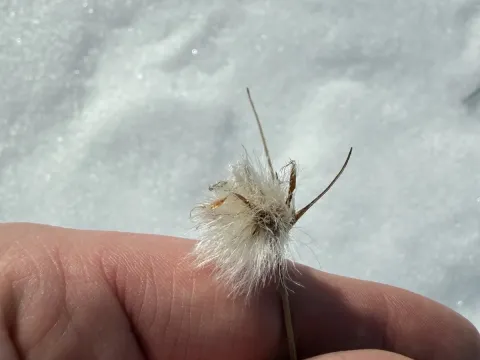
Seeds of cottongrass mature in late spring and are equipped with cotton-like bristles, allowing for effective wind dispersal in their natural bog habitats.
What the section contains

Cottongrass
For cultivation, seeds should be sown immediately after ripening, as they exhibit rapid loss of viability when dried out. Surface sowing on saturated media is essential for successful germination.
Vegetative propagation via clump division is the preferred agricultural method. Dividing mature specimens in early spring ensures rapid establishment in wet soil conditions.
Successful planting requires maintaining a high water table. Seedlings are highly susceptible to drought stress, making stable moisture the primary determinant for survival.
When establishing a plantation, a density of 6-9 plants per square meter is recommended to achieve quick ground cover and stabilize the peat layer.
Cottongrass belongs to the Cyperaceae family and is a specialized wetland plant adapted to acidic, nutrient-poor, waterlogged peat bogs.
The plant thrives in full sun exposure. In shaded environments, the characteristic cottony inflorescences remain underdeveloped, significantly reducing the plant's vigour.
Climate adaptability is high, as the genus is widely distributed across Arctic and temperate regions, showing excellent tolerance to freezing temperatures.
Soil requirements focus on acidity and saturation. Cottongrass is an indicator of high water tables and prefers soils where water remains at or above the surface level.
Minimal fertilization is required. The plant has evolved to extract nutrients from extremely poor substrates, and supplemental nutrients may actually harm the plant.
In terms of agricultural output, cottongrass serves mainly as early-season forage for reindeer in northern climates, providing vital nutrients after snowmelt.
The biomass potential is generally low compared to forage grasses, yet it is highly valued for its ability to grow in areas unusable for other crops.
The fibrous material, while historical in its use for stuffing, is limited by manual harvesting requirements, making it more of a specialty product than a commodity.
Its role in phytoremediation is significant, as the plant actively processes heavy metals and organic compounds in wetlands, providing ecosystem services.
Dry matter yields are estimated at approximately 1-2 tons per hectare, contingent upon the nutritional state of the bog and water flow conditions.
Habitat loss through drainage and land reclamation remains the most critical threat to cottongrass populations, as it destroys the required hydro-conditions.
Pathogens are generally minimal, but root rot can occur if stagnant, polluted water introduces anaerobic conditions or toxins that inhibit growth.
Pests are rarely a major issue, though drought-stressed plants are occasionally prone to aphid infestations, which can weaken the plant and reduce flower production.
Competition from invasive marsh species often results in the loss of cottongrass stands when bog ecosystems are disturbed by human activity.
- Drainage and soil aeration
- Chemical contamination of marsh ecosystems
- Encroachment of competitive shrubs and reeds
Harvesting of the cotton-like seed heads should occur just as they reach full maturity, before natural wind dispersal begins in the field.
Due to the delicate nature of the inflorescences, mechanical harvesting is impractical, necessitating manual labor to maintain the quality of the harvested fiber.
For grazing purposes, management involves rotational access, ensuring that the vegetation is not overgrazed during the early spring growth phase.
After harvest, the product must be dried in a well-ventilated, shaded area to prevent fungal degradation and preserve the structural integrity of the fibers.
Storage must be in dry, cool conditions to prevent the accumulation of moisture, which could lead to spoilage of the fibrous harvest.