
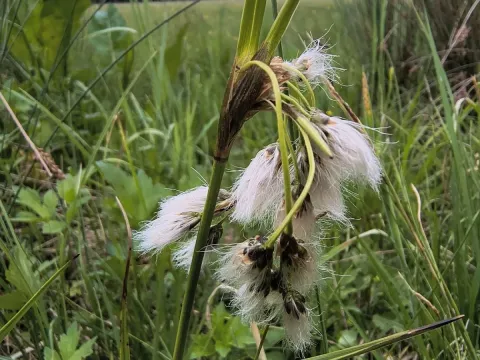
Broad-leaved cottongrass
Eriophorum latifolium
Broad-leaved cottongrass (Eriophorum latifolium) is a perennial herbaceous plant belonging to the Sedge family (Cyperaceae). It is native to wetlands, fens, and marshy habitats across Eurasia.
What the section contains
Broad-leaved cottongrass
Botanically, it is distinguished by its specific preference for alkaline or calcareous soils, unlike many other cottongrass species that favor acidic peat bogs. The plant forms dense, robust clumps with numerous leaf-bearing stems.
Cultivation requirements focus heavily on soil moisture; the substrate must remain consistently moist or wet throughout the entire growing season to ensure plant health.
In terms of climatic adaptation, it prefers cool to moderate temperatures and high atmospheric humidity. It is fully hardy and thrives in environments where seasonal water table fluctuations are minimal.
Economically, it is valued primarily in restoration ecology for stabilizing wet, limy soil surfaces and as a unique structural element in horticultural water garden designs.
The primary threat to the stability of a plantation is the sudden lowering of the water table, which leads to immediate desiccation and death of the root system.
Soil acidification represents a significant chemical threat; if the pH drops significantly, the nutrient uptake mechanisms of the plant are severely inhibited.
Fungal pathogens such as rusts can emerge during periods of poor air circulation, particularly if plants are grown in overly dense groupings without thinning.
Invasive weed species, especially aggressive grasses or sedges, can quickly outcompete broad-leaved cottongrass if the planting site is not properly managed initially.
While generally pest-resistant, aphids may occasionally congregate on the flower stems during early summer, though they rarely cause fatal damage to mature plants.