
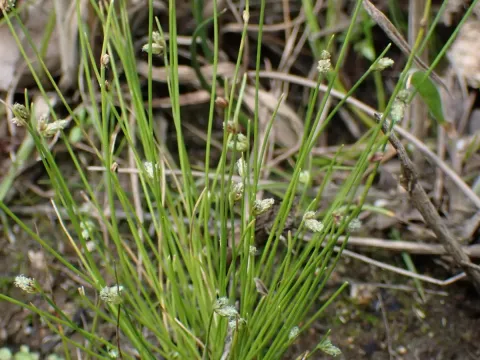
Bristle club-rush
Isolepis setacea
The bristle club-rush (Isolepis setacea) is a perennial herbaceous plant belonging to the Cyperaceae family. It is widely distributed across the globe, naturally inhabiting wetlands, damp meadows, and marshy areas across Europe, Asia, and Africa.
What the section contains
Bristle club-rush
This species is characterized by its high affinity for moisture, often referred to as a hygrophilous plant. It thrives in soils that remain constantly saturated, making it an excellent candidate for stabilizing the edges of ponds and slow-moving water bodies.
Botanically, it forms dense, low-growing tufts or clumps of thin, wire-like stems. Its root system is relatively shallow, which reinforces the plant's dependence on consistently high levels of soil moisture throughout the growing season.
Environmental requirements include a preference for semi-shaded to sunny positions, provided that the substrate does not dry out. It is relatively adaptable to different soil compositions, provided that the physical requirement for continuous water availability is met.
In landscape architecture, the bristle club-rush is prized for its fine texture, which adds a naturalistic look to water gardens and wet landscaping projects. It serves as a structural element that helps in defining shoreline borders while providing ecological shelter.
The bristle club-rush is generally robust and not prone to many of the common agricultural pests and diseases, largely due to its natural adaptation to aquatic and semi-aquatic environments where most terrestrial pathogens struggle.
The primary threat to the plant's health is drought or lack of water. Even short periods of soil dryness can lead to rapid wilting, chlorosis of the stems, and eventual mortality of the clump if the moisture is not restored immediately.
While insect damage is minimal, glasshouse-grown or ornamental specimens can occasionally suffer from infestations of spider mites, especially when the ambient humidity is too low or temperatures become excessively high.
Overcrowding in container cultivation may lead to poor air circulation, which might occasionally encourage the development of opportunistic fungal growths on decaying plant matter during the cooler months.
Good management practices involve ensuring proper spacing between plants and maintaining a clean growing area, free of large debris that could harbor harmful micro-organisms in the humid conditions this species requires.