
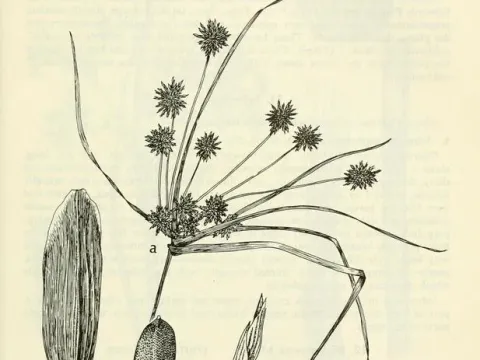
Luzula-flowered flatsedge
Cyperus luzulae
Luzula-flowered flatsedge (Cyperus luzulae) is a perennial herbaceous plant belonging to the Cyperaceae family. In agricultural and ornamental contexts, this species is recognized for its high affinity for wetland habitats and its unique aesthetic structure.
What the section contains
Luzula-flowered flatsedge
The plant originates from the tropical and subtropical regions of the Americas, spanning from the Caribbean to South America. In its natural habitat, it thrives in marshes, floodplains, and damp meadow ecosystems, reflecting its evolutionary adaptation to saturated soil conditions.
Botanically, the plant is distinguished by its dense clusters of linear leaves and distinctive inflorescences. These inflorescences are arranged in congested heads that resemble the genus Luzula, which serves as the primary inspiration for its common and specific scientific names.
Cultivation requirements focus primarily on water management. As a moisture-loving species, it requires consistently wet soil substrates to maintain turgor pressure and support rapid biomass development. It performs best under full sun or light partial shade conditions.
Soil quality must be rich in organic matter to provide the necessary nutrients for the perennial growth cycle. The soil should be slightly acidic to neutral and possess a high cation exchange capacity to hold the water and nutrients required for its intense metabolic activity.
Fungal pathogens represent the primary biological threat to this species, particularly when stagnant air conditions coincide with excessive humidity and cool temperatures. Root rot is the most common manifestation of these adverse growing conditions.
In terms of insect pests, spider mites can become problematic if the plant is maintained in environments with insufficient ambient humidity. These pests rapidly colonize the leaves, leading to chlorosis and premature senescence of the foliage.
Aphid infestations are frequently observed on the developing inflorescences, where these insects feed on nutrient-rich phloem sap. Integrated pest management strategies, focusing on biological controls, are recommended to preserve the plant's health and appearance.
Cultural practices such as thinning and pruning are essential for disease mitigation. Removing decaying organic matter from the base of the plant reduces the substrate for secondary pathogens and improves airflow within the clump.
Climate vulnerability is a limiting factor in non-tropical regions. The plant lacks significant frost tolerance, making it susceptible to cold injury if temperatures drop below freezing, necessitating indoor overwintering in climates with severe winters.