
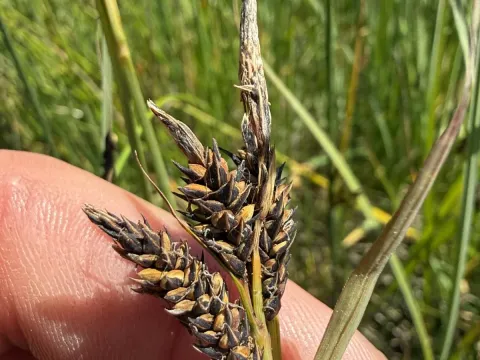
Lyngbye's sedge
Carex lyngbyei
Lyngbye's sedge (Carex lyngbyei) is a robust perennial plant belonging to the Cyperaceae family. It is characterized by extensive, creeping rhizomes that form dense mats, making it an excellent species for soil stabilization in saturated environments.
What the section contains
Lyngbye's sedge
Native to the coastal regions of the North Pacific, this sedge thrives in salt marshes, estuaries, and river deltas. It is adapted to survive periodic tidal inundation, which excludes many other plant species from its primary habitat.
The plant requires high soil moisture and demonstrates remarkable salt tolerance. It performs best in nutrient-rich, organic-based soils found in low-lying coastal areas, effectively utilizing the mineral availability of these waterlogged zones.
Cultural practices involve careful site selection to ensure consistent moisture levels. While it tolerates submersion, the plant benefits from brief periods of drainage to promote deeper root development and overall biomass accumulation.
Propagation is primarily achieved via rhizome division, which ensures rapid colonization of target areas. When planting, it is crucial to ensure good contact between the root system and the moist substrate to prevent desiccation during the establishment phase.
The primary agricultural and environmental use of Lyngbye's sedge is as a bio-engineering tool for erosion control along shorelines. Its extensive root system acts as a natural anchor, protecting vulnerable coastal zones from erosion.
It also serves as a potential forage source in brackish coastal meadows. Livestock may graze on the foliage where high salt levels make it difficult for standard fodder crops to survive, though it is often considered a secondary feed source.
This species is notably resilient against common agricultural pests and diseases. Its adaptation to saltwater environments creates a natural barrier against many terrestrial pathogens that typically plague forage crops.
Threats are mainly physical in nature, such as severe storm surges or major disruptions from human industrial activity. Insects may cause minor defoliation, but the plant's ability to regenerate via its robust rhizomatous system allows it to recover quickly from environmental stress.