
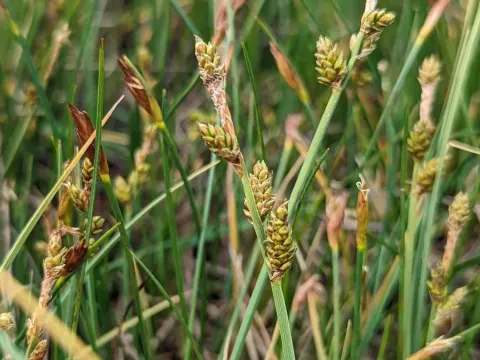
Mackenzie's sedge
Carex mackenziei
Mackenzie's sedge (Carex mackenziei) belongs to the Cyperaceae family. It is a perennial herbaceous plant known for its high adaptability to challenging environments within the northern temperate and arctic zones.
What the section contains
Mackenzie's sedge
The plant is categorized as a halophytic species, primarily thriving in salt marshes and coastal meadows. Its ability to tolerate salinity makes it a unique ecological agent in areas where most conventional agricultural crops would fail to establish.
Botanically, it features loose clumps or tufts and slender rhizomes. The leaves are generally narrow, and the flowering stalks produce specific inflorescences typical of the Carex genus, usually reaching a modest height of 15-40 centimeters.
Environmental requirements for this species include permanent moisture and proximity to brackish water sources. It prefers fine-textured soils, such as silt or organic-rich mud, which remain saturated throughout the growing season.
Regarding cultivation and management, Mackenzie's sedge is rarely farmed in a traditional sense but is valued for land reclamation and soil stabilization in coastal ecosystems. It effectively prevents erosion in sensitive northern coastal areas.