
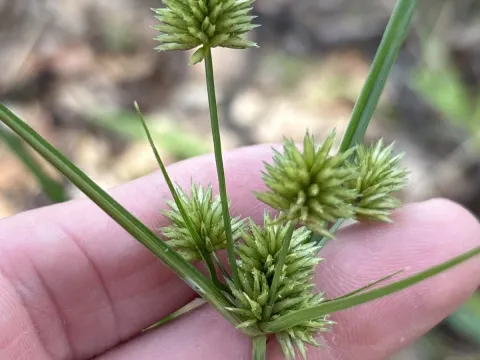
Globe flatsedge
Cyperus echinatus
Globe flatsedge (Cyperus echinatus) is a perennial herbaceous plant belonging to the Cyperaceae family. It is widely recognized for its spherical inflorescences that resemble a hedgehog, which gave the plant its common name.
What the section contains
Globe flatsedge
This species is native to the eastern parts of North America, where it thrives in open areas, prairies, and disturbed soils. It is well-adapted to a variety of environmental conditions, making it a resilient botanical specimen.
Botanically, it features triangular stems and rhizomes that allow it to form dense clusters. The plant performs best in full sunlight and is particularly fond of well-drained, sandy, or loamy soil textures.
From an agronomic perspective, it is known for its ability to persist in diverse moisture regimes, from moderately dry meadows to damp forest borders. Its ability to colonize space is supported by its efficient reproductive strategy.
While not typically cultivated for large-scale production, it provides essential ecological functions such as preventing soil erosion on slopes where other ground covers struggle to establish a root system.
The globe flatsedge is remarkably resilient to many common agricultural diseases. It does not typically suffer from significant fungal or bacterial infections that would decimate its populations, allowing it to maintain dominance in its habitats.
Pests such as specialized beetles and aphids may feed on the foliage, yet they rarely cause systemic failure of the plant. The robust rhizome system ensures survival even when the above-ground parts are heavily damaged or grazed.
In farming environments, the primary threat is the spread of this plant into adjacent crop fields, where it acts as a competitor for soil resources. Its deep root architecture makes traditional mechanical weeding methods challenging.
Chemical intervention remains the standard for management in areas where the plant becomes invasive. Herbicides targeting metabolic processes in monocots are generally effective if applied during the early vegetative stage.
Effective control strategies involve a combination of strategic tillage, which exposes rhizomes to desiccation, and the application of targeted post-emergence herbicides to prevent seed bank replenishment.