
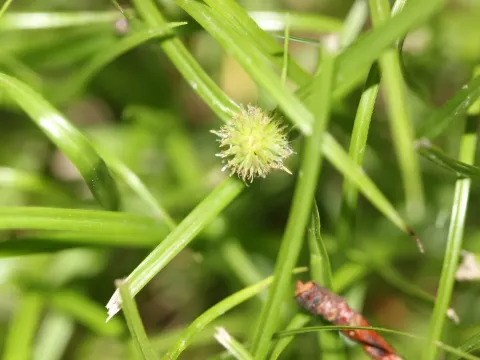
Green kyllinga
Cyperus brevifolius
Green kyllinga (Cyperus brevifolius) belongs to the Cyperaceae family. In an agricultural context, this plant is generally classified as a persistent weed rather than a crop, therefore deliberate sowing is never practiced.
What the section contains
Green kyllinga
The plant propagates primarily through an extensive system of rhizomes, which allow it to spread aggressively, and through seed production that persists in the soil seed bank.
Its natural range encompasses tropical and subtropical regions worldwide, where it thrives in warm and humid environments.
In temperate zones, its growth is limited to the warmer months, as it is highly sensitive to frost which damages its above-ground vegetative organs.
Control measures often focus on inhibiting its expansion during the early stages of the growing season when vegetative growth is most rapid.
This species requires high moisture levels and is typically found in poorly drained soils, wetlands, and areas with frequent water saturation.
It prefers well-aerated but moist organic soils with a pH ranging from slightly acidic to neutral for optimal physiological performance.
Green kyllinga shows remarkable tolerance to shade, enabling it to colonize areas beneath denser plant canopies where other weed species might struggle.
Thermal conditions are critical for its lifecycle; as a tropical-origin plant, it requires consistent heat to maintain rapid rhizome expansion.
Proper field management, including adequate drainage systems and soil preparation, is essential to prevent this sedge from becoming a dominant cover.
The plant is notoriously resistant to many commonly used herbicides, necessitating specialized chemical control protocols when dealing with infestations.
Nematodes are among the most significant pests affecting the root system, although they rarely provide effective biological control due to the plant's robust nature.
Green kyllinga can serve as an alternative host for various fungal pathogens that affect important cereal and horticultural crops.
The plant's resilience is further enhanced by its ability to regenerate quickly from small fragments of rhizomes left in the soil during cultivation.
Integrated pest management (IPM) strategies, combining mechanical tillage and targeted herbicide applications, are required to suppress its spread effectively.
There is no commercial harvesting for agricultural production as the plant is not considered a crop with economic utility in most farming systems.
In specific landscaping applications, it may be maintained as a ground cover in wet areas, requiring regular mowing to manage its height and spread.
Removal of the biomass is critical before seed head formation to prevent the dispersal of seeds across the cultivated area.
Disposal of harvested material should be handled with caution, ensuring that rhizomes are dehydrated or destroyed to prevent accidental re-establishment.
Mechanical removal through deep plowing helps to disrupt the rhizome network, though several passes are often necessary for complete eradication.