
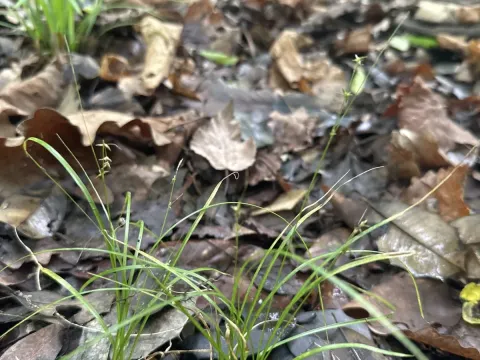
Social sedge
Carex socialis
Social sedge (Carex socialis) is a perennial herbaceous plant belonging to the Cyperaceae family. It is recognized for its clustering growth habit in moist environments.
What the section contains
Social sedge
The species is native to North America, primarily found in floodplains, wet meadows, and bottomland forests where moisture levels remain consistent.
Botanically, it features narrow, linear leaves and distinct inflorescence structures that allow for robust adaptation to riparian ecosystems.
The plant requires soils with high moisture-holding capacity, typically favoring loam or clay-loam substrates with adequate organic matter content.
Social sedge is tolerant of partial shade, making it a suitable species for planting under canopy cover in wetlands or along agricultural ditches.
In agricultural practice, social sedge serves primarily as a component of permanent pastures and buffer zones, providing essential soil stability.
Its deep root system makes it an excellent plant for erosion control along the edges of agricultural fields and irrigation channels.
While not a primary forage crop, it provides substantial biomass when managed as part of a mixed meadow system in flood-prone areas.
Managing the harvest timing is crucial; cutting before the flowering stage ensures the highest nutritional density for livestock consumption.
The plant is increasingly valued for its role in sustainable land management, acting as a natural filter for agricultural runoff in low-lying landscapes.
Fungal pathogens are the most significant threat to social sedge, particularly in years with prolonged spring rains or excessive standing water.
Rust diseases are common, appearing as yellowish or brown spots on the leaves, which can lead to reduced plant vigor if left unmanaged.
Insect pests, including various larvae of moths and beetles, may feed on the foliage, potentially stunting the growth of young plants.
To mitigate threats, farmers should ensure proper field drainage and avoid overstocking pastures, which can damage the soil structure and plant crowns.
Proper site preparation and selecting well-adapted companion grasses can increase the overall resilience of the stand against environmental and biological stresses.