
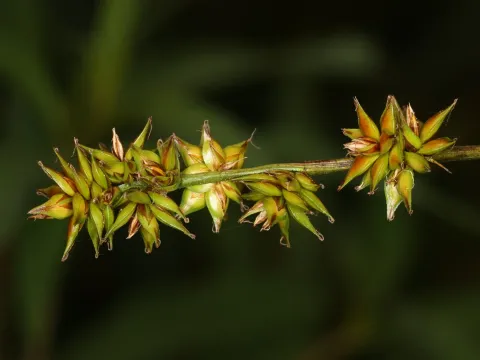
Spiked sedge
Carex muricata
Spiked sedge is a perennial grass-like plant belonging to the Cyperaceae family, often found in temperate grassland ecosystems across various continents.
What the section contains
Spiked sedge
In agricultural practice, sowing is typically carried out in late autumn to utilize winter cooling, which aids in the natural stratification of the seeds.
For successful germination, seeds should be sown at a shallow depth of approximately 1 centimeter, ensuring they are not smothered by excessive soil coverage.
Maintaining proper spacing between rows is essential to allow the plant's dense tufts to develop without excessive competition for sunlight and space.
Uniform seed distribution is critical, especially when establishing permanent meadows or pastures, to ensure a high-quality forage cover.
Carex muricata demonstrates high adaptability, preferring moist, well-drained soils, but it can tolerate a wide variety of soil types, including sandy loams.
The plant thrives in both semi-shaded and sunny conditions, making it an excellent candidate for inclusion in diverse meadow seed mixtures.
It is well-suited for temperate climates, showing high cold tolerance and the ability to withstand seasonal temperature fluctuations throughout the year.
Optimal pH levels for growth typically range from slightly acidic to neutral, mirroring the conditions of its natural habitats in pastures and woodlands.
While hardy, the plant benefits from balanced nutrient levels, particularly phosphorus and potassium, during the early stages of its development.
Spiked sedge is primarily utilized as a forage component in semi-natural grasslands, providing early spring biomass when other grasses are just beginning to grow.
The total yield of green biomass depends heavily on soil moisture levels and the overall health of the ecosystem in which the plants are established.
Its nutritional value is highest before the onset of the flowering phase, making timely harvesting or controlled grazing essential for maximizing feed quality.
Beyond forage, it serves as a valuable plant for erosion control and environmental restoration due to its robust root system that stabilizes topsoil.
- Suitable for light grazing regimes in sustainable farming.
- Provides habitat and food for beneficial wildlife species.
- Contributes to soil structure improvement in degraded lands.
Fungal diseases, particularly rusts and mildews, represent the most common threat to Spiked sedge, especially under conditions of high humidity and poor air circulation.
Pest damage, though relatively low compared to cereal crops, can occur from soil-borne larvae that target the root systems of younger plants during dry spells.
Overgrazing poses a significant risk to the longevity of stands, as it depletes the energy reserves stored in the rhizomes of the plant.
Competition from invasive plant species can hinder the establishment of new stands, requiring careful management during the initial growth cycle.
Proactive monitoring and the implementation of strategic grazing rotations help mitigate risks and maintain the long-term health of the crop.