
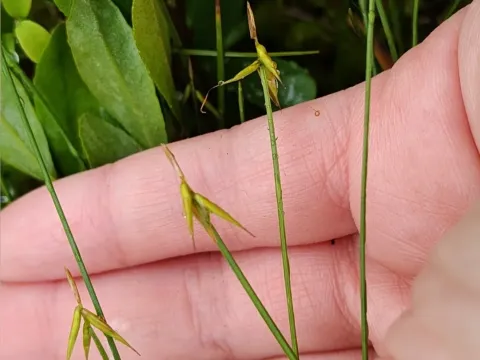
Few-flowered sedge
Carex pauciflora
The few-flowered sedge (Carex pauciflora) is a perennial plant belonging to the Cyperaceae family. It is a highly specialized species that exclusively thrives in specific wetland environments, particularly in acidic peatlands and sphagnum bogs.
What the section contains
Few-flowered sedge
Its natural range encompasses the circumpolar regions of the Northern Hemisphere, spanning across northern Eurasia and North America. It is considered a stenotopic species, meaning it is restricted to a narrow range of environmental conditions, primarily waterlogged habitats.
Botanically, it features a slender culm and rhizomatous growth. The species is named for its inflorescence, which is a small spike containing only 2 to 5 flowers. It reaches heights of approximately 10 to 30 centimeters and is often overlooked due to its sparse appearance.
It requires extremely moist, nutrient-poor, and acidic soil conditions to survive. It cannot be cultivated in traditional agricultural settings as it lacks the physiological mechanisms to compete in mineral-rich, disturbed, or well-drained soils, making it strictly a wild ecological species.
From an agricultural and economic perspective, this plant provides no direct yield or forage value. However, it plays a vital ecological role in the accumulation of peat and the maintenance of bog biodiversity, serving as an indicator of pristine, undisturbed wetland systems.
The primary threat to the stability of Carex pauciflora populations is the drainage of wetlands for agricultural land reclamation. As the water table drops, the sensitive bog habitat dries out, causing the sedge to be rapidly replaced by competitive upland vegetation.
Fungal infections, such as those caused by rusts or smuts, can occur under sub-optimal conditions. However, in healthy, highly acidic environments, these pathogens are usually limited by the natural chemical defenses and environmental stressors inherent to the bog ecosystem.
While various insect herbivores may feed on sedge foliage, there are no specific pests known to decimate Carex pauciflora populations significantly. The most significant threat remains habitat destruction and fragmentation.
Water quality degradation due to runoff from industrial or agricultural areas, specifically nitrogen and phosphorus loading, poses a severe risk to the species. Increased nutrient levels favor aggressive invaders that outcompete this slow-growing, sensitive native sedge.
Climate change poses a long-term risk to this species, as it is adapted to cool, temperate, and arctic climates. As average temperatures rise, the niche space available for this cold-adapted plant continues to shrink, potentially leading to local extinctions.