
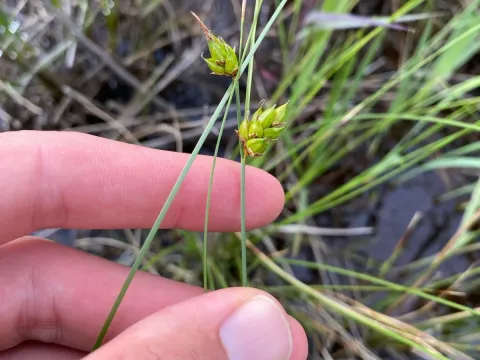
Few-seeded sedge
Carex oligosperma
The Few-seeded sedge (Carex oligosperma) is a perennial herbaceous plant from the Cyperaceae family. It is a highly specialized species adapted to thrive in nutrient-poor wetland environments, such as fens and bogs.
What the section contains
Few-seeded sedge
The native range of the species encompasses the northern regions of the Northern Hemisphere, spanning across Canada, the United States, and Eurasia. It is commonly found in acidic, nutrient-deficient peatlands where competitive pressure from other flora is low.
Botanically, it is characterized by creeping rhizomes that form loose to dense mats. The culms are slender and smooth, growing up to 60 cm in height. The inflorescence is sparse, typically producing only a few fruits, which is the origin of its scientific name.
Regarding habitat requirements, the plant strictly necessitates acidic, oligotrophic (nutrient-poor) peat substrates. Constant saturation or standing water is essential for its physiological functions, making it a reliable indicator for wetland mapping.
Economically, the Few-seeded sedge is primarily valued for its role in peat formation and soil stabilization. It acts as a keystone species in peatland ecosystems, helping to sequester carbon and provide habitat for specialized fauna.
The primary threat to the Few-seeded sedge is the alteration of hydro-regimes caused by industrial drainage and peat extraction. Once the water table drops, the species quickly loses its competitive advantage and disappears from the site.
Fungal pathogens represent the main biological threat. Rust fungi may occasionally colonize the leaves during high-humidity seasons, although these outbreaks are usually self-limiting in healthy, well-established populations.
Human activities, such as excessive trampling by livestock in wetland areas, can damage the rhizome mat, leading to localized erosion. Protecting these areas from direct mechanical disturbance is vital for the preservation of the sedge.
Nitrogen deposition and chemical runoff from adjacent agricultural lands can be detrimental. As an oligotrophic plant, it is extremely sensitive to changes in soil chemistry, specifically an increase in nitrates which facilitates the growth of invasive weeds.
Long-term survival depends on maintaining pristine wetland conditions. Monitoring of hydrological parameters is the most effective management strategy to ensure the health and distribution of these sedge populations.