
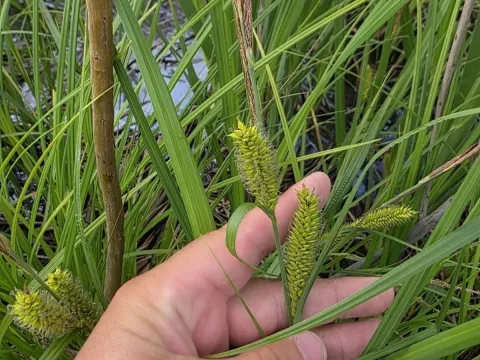
Lake sedge
Carex lacustris
Lake sedge (Carex lacustris) is a robust perennial herb belonging to the Cyperaceae family. It is naturally adapted to wet environments, thriving in lake margins, marshes, and saturated lowlands where other conventional crops fail to establish.
What the section contains
Lake sedge
The plant features a vigorous underground rhizome system that allows it to spread rapidly, forming dense colonies. This makes lake sedge a valuable species for soil stabilization and environmental restoration projects along aquatic margins.
Regarding soil requirements, this species favors rich, organic, and highly saturated substrates. It exhibits remarkable tolerance for acidic soil conditions and can withstand seasonal flooding, which is a major advantage in marginal land management.
Climate adaptability is one of its core strengths. Lake sedge is highly winter-hardy and can endure cold climates without significant damage, provided there is adequate moisture in the soil to protect the root systems during the dormant season.
Optimal growth is achieved in sunny locations, although the plant shows flexibility and can persist in partial shade. Proper moisture management remains the most critical factor for maintaining the vigor of a lake sedge population.
The primary agricultural output of lake sedge is biomass, which can be harvested for various applications. While its nutritional profile is generally lower than traditional cereal grasses, it serves as a sustainable source of fodder when harvested at the right phenological stage.
Beyond animal feed, lake sedge is increasingly recognized for its use in phytoremediation. Its dense root network effectively absorbs nitrogen and phosphorus from water, making it a natural choice for filtering agricultural runoff and managing wastewater.
Industrial potential is also being explored, particularly regarding the use of its fiber for sustainable mulch, composting, or as a raw material for cellulose-based products. Its fibrous structure provides durability and slow decomposition, which is beneficial for soil improvement.
In some regions, it is harvested to produce bedding material for livestock. Its high absorption capacity and resistance to rapid decay make it an economical and eco-friendly alternative to straw in wet animal housing conditions.
The plant demonstrates high productivity, often out-competing other species in its niche. With sustainable management, a stand can produce consistent yields annually, contributing to a diversified farm portfolio in wetland zones.
Lake sedge is naturally resistant to many agricultural pests, but it is not immune to certain fungal pathogens, particularly smut fungi that can infect the inflorescences. These diseases generally emerge in areas with poor airflow and excessive moisture stagnation.
Pest pressure from leaf-mining insects or mollusks can occur in early spring, especially during humid weather. While these rarely destroy a full colony, they can weaken the vitality of younger stands and reduce total biomass production for the season.
The most significant threat is the alteration of hydrological conditions. Prolonged droughts can cause the death of the rhizomes or lead to the invasion of more drought-tolerant species, effectively ending the productivity of the lake sedge stand.
Management strategies focus on maintaining water levels and ensuring the stands do not become overly congested. Thinning out dead plant matter regularly helps to improve overall ecosystem health and reduces the habitat for potential pests.
Since these plants are often located near water bodies, the use of pesticides is strictly avoided. Integrated pest management, centered on maintaining optimal plant vigor through water regulation, remains the standard practice.
Harvesting lake sedge requires precision to ensure the longevity of the perennial stand. For forage purposes, the harvest must occur in late spring before the plant stems become too lignified and lose their palatability.
Equipment usage depends heavily on the terrain. In soft, marshy areas, low-ground-pressure machinery or even hand-harvesting methods are necessary to prevent damage to the soil structure and to ensure the rhizomes remain intact for future regrowth.
Drying is a critical step in the harvest process. Given the plant's natural adaptation to moisture, its stems retain water efficiently, meaning that cut material requires sufficient time in the sun or active aeration to reach a stable moisture content for storage.
A cutting height of at least 10–15 centimeters is recommended. This height allows for rapid recovery, ensuring that the plant can continue its vegetative growth throughout the remainder of the summer season.
When harvested for industrial use, such as biomass for energy or bedding, timing can be extended to late summer. At this stage, the material is tougher, provides more fiber, and is easier to handle and store for long-term use.