
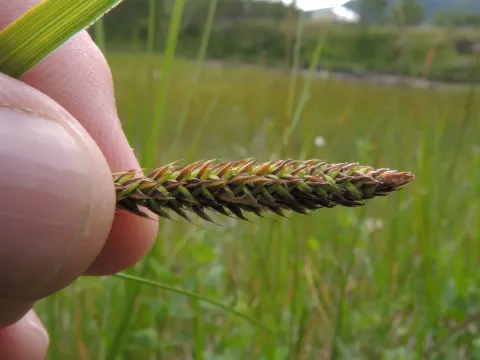
Salt-loving sedge
Carex halophila
Salt-loving sedge (Carex halophila) is a perennial herbaceous plant belonging to the Cyperaceae family. It is a true halophyte, specialized in thriving in environments where soil salinity levels exceed the tolerance of common agricultural crops.
What the section contains
Salt-loving sedge
In its natural habitat, the plant is typically found in coastal marshes, salt meadows, and around brackish water bodies. Its geographical range extends across northern and temperate regions, where it demonstrates remarkable cold tolerance and adaptation to harsh edaphic conditions.
Botanically, this species features a vigorous root system, often rhizomatous, which allows it to stabilize itself in shifting or compacted saline substrates. The leaves are typically narrow and stiff, possessing specialized stomatal control to minimize transpiration under osmotic stress.
The cultural requirements are centered on moisture management. While tolerant to salt, the plant relies on adequate water availability to support its metabolic processes. It withstands periodic waterlogging, making it ideal for saline wetlands.
Agronomic practices for Carex halophila are minimal, as the species is essentially a wild-growing plant adapted to low-input scenarios. There is no need for conventional fertilizers, which could actually disrupt its specific physiological balance in salt-affected soils.
The agricultural utility of salt-loving sedge is primarily as a forage resource for livestock in areas where conventional grasses cannot survive. It provides a reliable source of green mass in ecological zones characterized by high soil salinity.
Beyond forage, the species is vital for soil restoration. Its extensive root structure acts as an excellent soil binder, reducing wind and water erosion on vulnerable coastal and saline lands that are otherwise prone to degradation.
The yield of green matter is highly dependent on the hydro-regime of the site. Under optimal moisture conditions, the sedge forms a dense stand that can be harvested as hay, though the physical structure of the plant requires heavy-duty machinery due to its tough texture.
The harvested biomass can be composted or used as organic mulch. When applied to saline fields, it helps retain soil moisture and slowly releases organic matter, facilitating the long-term improvement of soil structure and biological activity.
Landscape utilization is another growing sector. Due to its unique aesthetic and salt-tolerance, Carex halophila is increasingly used in sustainable landscaping and shoreline stabilization, creating zero-maintenance green buffers around salt lakes.
Salt-loving sedge exhibits high natural resistance to most fungal and bacterial diseases that affect traditional cereal crops. This immunity is largely attributed to its unique cellular chemistry, which creates an inhospitable environment for common pathogens.
Pest pressure on this species is typically low. While certain specialized herbivores may graze on the foliage, the plant's hardy nature allows it to recover quickly unless the infestation is persistent and covers a very large area.
Fungal issues such as rust may occur during periods of excessive humidity or stagnation. To prevent these conditions, land managers should ensure adequate water drainage and prevent the creation of air-stagnant zones within the sedge stands.
Human impact, particularly overgrazing, remains the primary threat to the longevity of these stands. Implementing a rotation grazing schedule ensures that the root systems have sufficient time to recover, maintaining the long-term viability of the population.
The use of chemical pesticides is generally unnecessary and discouraged, as the plant is an essential component of the local ecosystem. Relying on biological balance and environmental management is the most effective way to protect this valuable resource.