
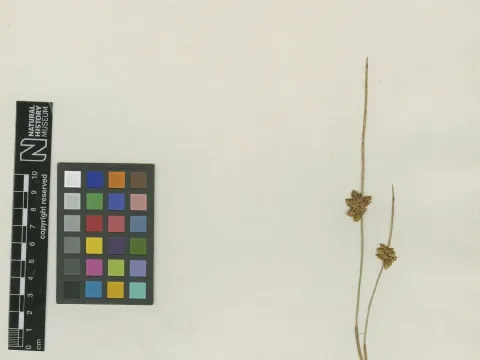
Royle's bulrush
Schoenoplectus roylei
Royle's bulrush (Schoenoplectus roylei) is a member of the Cyperaceae family. It is a perennial aquatic plant that spreads primarily through rhizomes, creating dense colonies in suitable wetland environments.
What the section contains
Royle's bulrush
Propagation for commercial purposes is often done through rhizome division. This method ensures high survival rates and rapid expansion of the stand once established in the intended aquatic site.
Seeds can be used for propagation, though they require specific environmental conditions, including consistent moisture and warmth, to germinate effectively in nursery environments.
Planting in spring is recommended, as the warmer temperatures facilitate root development. Spacing should be approximately 50 centimeters apart to prevent excessive competition for nutrients during the initial growth phase.
The plant adapts well to varying water levels, but stability in the early weeks post-planting is crucial for ensuring the rhizomes anchor properly into the substrate.
As a true hydrophyte, Royle's bulrush requires constant saturation. It is native to marshes, riverbanks, and shallow pond edges, making it ideal for riparian restoration projects.
The soil should be nutrient-rich silt or clay. While the plant can survive in diverse substrates, it exhibits its most vigorous biomass production in organic-rich, silty environments.
Sunlight is an essential factor. Royle's bulrush is a heliophilous species that requires full sun exposure to maintain sturdy stems and healthy, deep green foliage.
Water quality is important; the plant prefers neutral to slightly acidic pH levels. It is known to absorb excess nitrogen and phosphorus, which helps in improving water clarity.
Management practices include monitoring the depth of the water to ensure the plant crowns are not submerged under too deep water, which can hinder gas exchange.
Fungal diseases are the primary threat, particularly in environments with poor water circulation. Stagnant conditions often lead to leaf spot and stem rot, which can decimate a stand if ignored.
Common pests include aphids and specific larvae that bore into the stems. These pests can weaken the plant's structural integrity, making it more susceptible to environmental stress.
Preventive measures include managing the plant density to ensure adequate airflow around the stems. Periodic thinning helps prevent the buildup of pathogens within dense clusters.
If chemical interventions are necessary, they must be chosen with extreme caution, as the plant typically resides in sensitive aquatic ecosystems that host other aquatic life.
The overall resistance of the species is high, but constant monitoring for early signs of yellowing or stem lesions is a standard part of good agricultural practice.
Harvesting usually occurs in late summer before the plant enters senescence. Cutting the stems cleanly above the waterline ensures the rhizome remains intact for the next season's growth.
The biomass is collected and dried in the open air, which is a traditional and effective method for preserving the material for future use in construction or decorative arts.
The harvested material is versatile, valued for its durability and flexibility. It serves as a sustainable resource for creating eco-friendly fiber products and filtration media.
Harvesting also serves a secondary purpose: it removes the nitrogen and phosphorus stored in the stems from the aquatic system, effectively completing the phytoremediation cycle.
Proper harvest management is the key to longevity. By avoiding root damage, growers can maintain productive stands for decades without the need for replanting.