
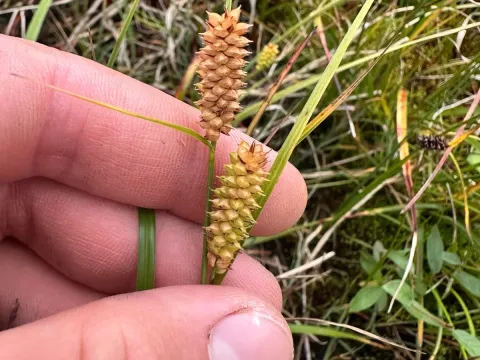
Round sedge
Carex rotundata
Round sedge (Carex rotundata) is a perennial herbaceous plant belonging to the Cyperaceae family. It is widely distributed across the circumpolar regions, including the Arctic and subarctic zones of Eurasia and North America, where it thrives in diverse wetland ecosystems.
What the section contains
Round sedge
The plant is highly specialized for habitats characterized by persistent moisture. It typically occupies peat bogs, the margins of arctic lakes, and wet tundra meadows. It is highly adapted to acidic, nutrient-poor soil conditions and cold climates where the growing season is significantly restricted.
Botanically, the species is defined by its long, creeping rhizomes, which allow the plant to form extensive, clonal patches. Its foliage is notably tough, and the inflorescence consists of distinct spikes that are well-adapted to wind pollination, a common survival strategy in open northern landscapes.
Regarding its requirements, the round sedge demands a high water table and stability in the hydrological environment. It thrives in soils that remain saturated or waterlogged, which prevents competition from more demanding upland grass species. Proper management of these areas is essential for maintaining natural vegetation stability.
The main agricultural and ecological use of this species is as a primary forage crop for reindeer. In the pastoral systems of the northern territories, it serves as a crucial nutritional source during the spring and summer months, supporting animal health and herd productivity in challenging northern environments.
The primary threats to round sedge populations include regional climate change, which impacts permafrost and water levels, and the overgrazing of sensitive wetlands. While the plant is inherently resilient, it can be susceptible to localized fungal pathogens if the soil conditions become stagnant or overly polluted by agricultural runoff.