
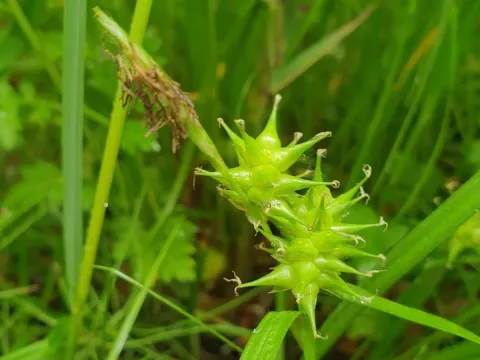
Carex dickinsii
Carex dickinsii
Carex dickinsii is a perennial herbaceous plant belonging to the Cyperaceae family. It is native to East Asia, primarily distributed across Japan, China, and Korea, where it thrives in moist, riparian environments.
What the section contains
Carex dickinsii
This species is well-adapted to habitats with high soil moisture levels. It frequently occupies wetlands, marshy edges, and damp meadows, making it an excellent candidate for aquatic landscape management.
The plant requires fertile, moisture-retentive soils. Loamy textures with high organic matter content and a pH range of 5.5 to 7.0 are ideal for supporting vigorous root development and foliage growth.
Climatic requirements focus on temperate conditions. Carex dickinsii demonstrates significant resilience to seasonal water saturation, which is a critical feature for successful cultivation in boggy areas.
Light exposure should be balanced; while the plant tolerates partial shade, full exposure to morning sunlight promotes the best aesthetic structure and prevents the thinning of the plant's clumps.
Vegetative propagation via clump division is the standard method for establishing Carex dickinsii. This technique ensures rapid establishment and uniformity across the planting area.
Optimal timing for division is during the early spring before the initiation of rapid shoot growth. Dividing plants at this time allows the root system to re-establish during the favorable spring conditions.
If propagation from seeds is required, a period of cold stratification is necessary to break dormancy. Seeds should be sown in a shallow medium, as light is often a trigger for successful germination.
Maintenance during the establishment phase involves ensuring the soil remains consistently moist. Irrigation must be frequent enough to prevent the root ball from drying out during the first growing season.
Planting density should be calculated based on the desired coverage. Spacing of 25 to 35 centimeters between individual plants is generally recommended to allow for adequate expansion of the rhizomatous root system.