
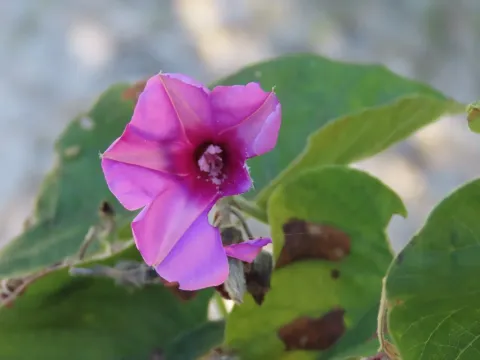
Ipomoea rubens
Ipomoea rubens
Ipomoea rubens is a robust climbing plant belonging to the Convolvulaceae family. While native to tropical regions, it is frequently cultivated in various climates for its rapid growth rate and ornamental value.
What the section contains
Ipomoea rubens
The sowing season typically begins in early spring. In cooler regions, seeds should be started indoors in trays or pots about six to eight weeks before the last frost date to ensure a vigorous start.
Seeds have a hard seed coat and benefit significantly from scarification or soaking in tepid water for 12 to 24 hours prior to planting. This process softens the outer layer and facilitates faster germination.
When transplanting to the field, it is crucial to handle the root system with extreme care as these plants are sensitive to disturbance. Spacing should be sufficient to allow for full expansion and airflow between vines.
Direct sowing in the open field is only recommended once soil temperatures consistently exceed 15 degrees Celsius. The site must be chosen with access to sturdy support structures to accommodate the climbing habit of the plant.
This crop thrives in fertile, well-draining soil that is rich in organic matter. While it is adaptable to various soil textures, it performs best in loamy substrates with a near-neutral pH level.
Water requirements are relatively high during the active growth phase. Consistent soil moisture is necessary to support the plant's rapid biomass production, though it cannot tolerate waterlogged conditions which promote root rot.
Sunlight is a critical factor for successful cultivation. Ipomoea rubens requires full sun exposure for at least six to eight hours per day to achieve optimal flower production and strong structural growth.
Nutrient management involves applying balanced fertilizers during the early vegetative stage. As the plant begins to bloom, shifting to fertilizers higher in potassium and phosphorus helps maintain high flower density.
Climatic adaptability is limited to frost-free environments. In regions with cold winters, the plant is usually treated as an annual, as it is killed instantly by even minor exposure to freezing temperatures.
Pest management is an essential component of Ipomoea rubens maintenance. Spider mites are the most common concern, particularly in dry, arid conditions, causing foliage discoloration and premature leaf drop.
Aphids can frequently be found clustering on new, tender growth. If left unmanaged, their feeding habits can lead to leaf curling and stunted shoot development, often requiring targeted insecticidal treatments.
Fungal issues, including various blights and leaf spots, may occur when air circulation is poor. Maintaining adequate spacing and avoiding overhead irrigation during humid weather helps mitigate these risks significantly.
Viral infections can occasionally occur, manifesting as mottled leaf patterns or deformed growth. Since there is no curative treatment for viral diseases, infected plants must be removed to protect the remaining crop.
General hygiene, such as removing debris and weeds around the base of the vines, reduces the prevalence of both pests and disease-carrying pathogens within the planting area.