
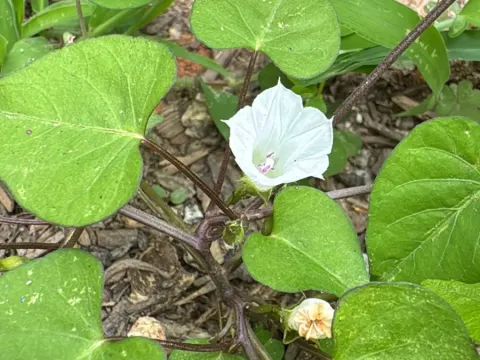
Ipomoea lacunosa
Ipomoea lacunosa
Ipomoea lacunosa is a warm-season annual plant that requires significant soil warmth for germination. Seeds typically begin to sprout when soil temperatures reach at least 20 degrees Celsius.
What the section contains
Ipomoea lacunosa
The emergence of this species usually occurs throughout the late spring and early summer. It is known for having a long-lasting seed bank, which can cause erratic emergence patterns after rainfall events.
The depth of seed placement in the soil profile is critical. Seeds buried deeper than 5 centimeters often show reduced emergence rates, though they may remain dormant for several seasons.
Agronomists suggest using stale seedbed techniques before planting main crops to exhaust the surface weed seed bank. This is highly effective against the small-seeded pitted morning glory.
Staggered planting times can sometimes aid in managing this weed, as early-planted crops often gain enough height advantage to shade out the emerging seedlings of Ipomoea lacunosa.
This species thrives in full sun exposure and is highly competitive in high-input agricultural environments. It belongs to the Convolvulaceae family, which is known for vigorous vine growth.
Soil requirements include well-drained, fertile conditions. Pitted morning glory is particularly successful in rich loam and clay soils where moisture availability is consistent throughout the season.
While it is tolerant of a wide pH range, it performs best in neutral to slightly alkaline soils. Proper soil structure is essential, as the plant can develop deep taproots to scavenge for nutrients.
The plant is highly sensitive to shading. Once a crop canopy is fully closed, the growth rate of Ipomoea lacunosa significantly decreases, highlighting the importance of high-density planting.
Adequate nitrogen levels in the soil provide a competitive advantage to this weed. Therefore, precise fertilizer placement is recommended to minimize nutrient uptake by non-crop vegetation.
Pitted morning glory serves as an alternative host for various crop diseases, including several types of viruses that can be transmitted by insects like aphids and whiteflies.
Fungal pathogens such as leaf spot are frequently observed on Ipomoea lacunosa. These infections can act as a secondary source of inoculum for surrounding susceptible crops.
Pests such as spider mites frequently inhabit these plants early in the season. As the season progresses, they often migrate to nearby soy or vegetable crops, causing significant damage.
The main threat posed by this plant is its ability to vine around crop stems, which can interfere with harvesting equipment and lead to lodging of the main crop.
Control measures must be integrated, including the use of pre-emergent and post-emergent herbicides, mechanical cultivation, and proper crop rotation to break the weed's life cycle.
The presence of Ipomoea lacunosa at harvest time poses a significant technical challenge due to its vining nature. Large infestations can entangle harvesting machinery, causing downtime.
Mechanical harvesting efficiency is reduced when plants are tangled in the crop canopy. This may result in increased grain loss and slower machine operating speeds.
In cases of heavy infestation, pre-harvest drying agents or desiccant applications may be necessary to ensure that the vines are sufficiently dry for efficient mechanical separation.
Weed management should be focused on the earlier stages of crop development, as managing mature vines during the harvest window is both costly and difficult.
Clean harvesting practices and proper combine adjustments are required to minimize the spread of seeds during the harvest process, especially if the infestation is localized.