
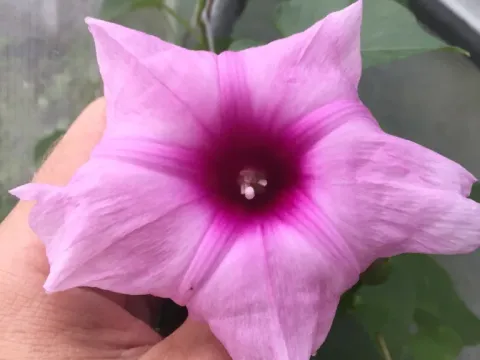
Ipomoea hybrid
Ipomoea hybrids
Ipomoea hybrid is an annual heat-loving vine from the Convolvulaceae family, which is widely cultivated as an ornamental plant. Most modern hybrids originate from tropical species, making the plant extremely sensitive to frost.
What the section contains
Ipomoea hybrid
Direct sowing in open ground is performed only after the weather has become consistently warm, with soil temperatures reaching 15-18 degrees Celsius. In temperate climates, it is recommended to start seedlings indoors 3-4 weeks before planting.
Ipomoea seeds have a hard outer coat, so soaking them in warm water for 24 hours before planting is recommended to improve germination rates. The sowing depth should be approximately 1-2 centimeters.
When starting from seeds, it is important to use peat pots, as the plant does not tolerate root damage during transplanting. Moving the plants to their permanent location must be done carefully with the root ball intact.
The optimal time for transplanting usually occurs at the end of May, once the risk of late spring frosts has completely passed, as these can be fatal to young Ipomoea shoots.
This crop has high light requirements; for abundant flowering and active foliage development, Ipomoea needs well-lit locations sheltered from strong winds.
The soil for successful cultivation must be loose, nutrient-rich, and have a neutral pH level. Heavy clay soils should be amended with organic matter and sand to improve drainage properties.
Ipomoea requires regular watering, especially during the hot summer months. It is critical to avoid waterlogging in the root zone, as this can lead to root rot and the subsequent death of the vine.
Using supports is a mandatory agrotechnical requirement. Since it is a climbing plant, trellises, nets, or taut wire structures are necessary to create vertical garden features or living screens.
Fertilization should be carried out every 2-3 weeks during the growing season using balanced fertilizers with a moderate nitrogen content to encourage flowering rather than excessive vegetative growth.
The main pests of Ipomoea hybrids are aphids and spider mites, which typically infest the plants during dry and hot weather. Regular inspection of the undersides of the leaves helps to detect pest colonies early.
To combat sap-sucking pests, systematic insecticides or biological control agents should be applied, strictly following the manufacturer's dosage instructions.
Diseases most often arise due to improper moisture management. Over-saturation of the soil can trigger various types of rot that affect the root neck and the base of the stem.
Powdery mildew can also become an issue under conditions of high air humidity and poor air circulation. Proper spacing between plants during sowing acts as a key preventive measure.
If signs of fungal infection appear, it is necessary to remove affected plant parts and treat the remaining plants with broad-spectrum fungicides.