
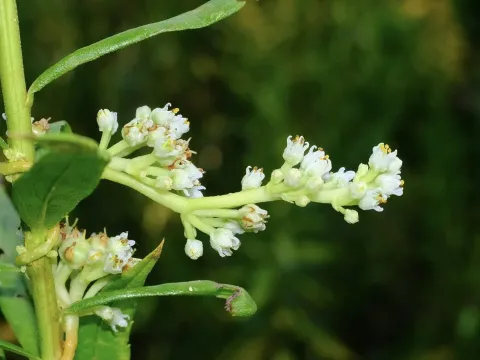
Hazel dodder
Cuscuta coryli
Hazel dodder (Cuscuta coryli) is a parasitic plant belonging to the Convolvulaceae family. It is characterized by its lack of chlorophyll and root systems, which makes it entirely dependent on host plants for its survival, growth, and reproduction.
What the section contains
Hazel dodder
Native primarily to North America, the plant exhibits a preference for various woody and herbaceous hosts. As a parasitic species, it uses specialized structures called haustoria to penetrate the vascular tissues of the host to extract water and nutrients.
The climate requirements for Cuscuta coryli are broad, as it thrives in diverse environments where suitable host plants are available. It grows best during warm, moist periods that encourage rapid stem elongation and expansion across host tissues.
Soil conditions are less critical for the dodder itself since it does not rely on soil nutrients. However, the presence of seed banks in the soil allows it to persist over long durations, making it a difficult weed to eradicate once a field is contaminated.
Cultural management practices are essential to prevent infestation. Key methods include using high-quality weed-free seed lots, implementing crop rotation with resistant species, and maintaining strict sanitary barriers to prevent the introduction of seeds into new areas.
The primary threat posed by hazel dodder is the physical and physiological stress inflicted upon host plants. By diverting sugars and mineral resources, the parasite severely stunts the growth and development of crops, leading to significantly lower yields.
Another major concern is the role of the parasite as a vector for various plant pathogens. Cuscuta coryli can easily transmit viral and phytoplasmal diseases between infected and healthy plants, complicating crop protection efforts significantly.
Controlling this parasite is notoriously challenging due to the intimate physiological connection between the dodder and its host. Standard herbicide applications are rarely effective without damaging the underlying crop that needs protection.
The most effective strategy involves early detection and physical removal of the infested host tissues. Infested areas should be burned or disposed of far from agricultural fields to prevent the maturation and dispersal of new seeds.
Integrated pest management protocols require ongoing monitoring throughout the growing season. Following strict quarantine measures and maintaining a clean fallow period can significantly reduce the risk of future dodder population outbreaks on the farm.