
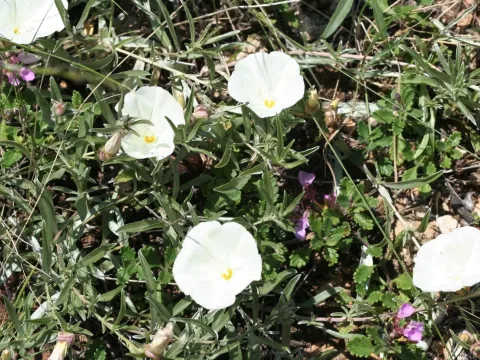
Silky bindweed
Convolvulus holosericeus
Silky bindweed (Convolvulus holosericeus) is a perennial herbaceous plant belonging to the Convolvulaceae family. It is distinct for its dense, silvery-white hairs that cover its leaves and stems, serving as a specialized adaptation to survive in arid, high-sunlight environments.
What the section contains
Silky bindweed
The plant originates from the dry, rocky terrains of Southern Europe and the Balkan region. It has evolved to thrive in nutrient-poor, rocky substrates where water retention is low and temperatures can be extreme.
Successful cultivation requires full sun exposure. In gardening and experimental agriculture, it serves as an excellent ground cover for xeriscaping or areas where minimal maintenance is required due to its high drought tolerance.
The soil must be exceptionally well-drained. Heavy soils should be amended with grit, sand, or gravel to prevent the roots from rotting, which is the primary cause of failure when attempting to grow this species in non-native climates.
Minimal fertilization is required for this plant. In fact, over-fertilizing can lead to excessive, weak growth that reduces the plant's natural resistance to environmental stress and its compact habit.
The most common health issues for Convolvulus holosericeus are fungal infections such as powdery mildew or root rot, which are almost always linked to poor drainage or overly humid climatic conditions.
Pests such as aphids and spider mites can occasionally affect the plant, particularly during prolonged periods of drought when the plant's overall vigor is taxed.
To manage threats effectively, focus on providing adequate air circulation around the canopy and ensuring the root zone never sits in stagnant water.
Chemical intervention should be a last resort. Cultural methods, such as pruning damaged areas and correcting environmental conditions, are far more effective for maintaining the plant's health.
Weed competition can hinder the establishment of this species during its early growth phases, so keeping the surrounding area clear is essential for long-term survival.