
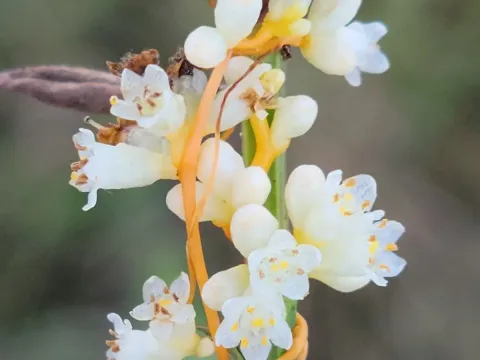
Smoothseed alfalfa dodder
Cuscuta obtusiflora
Smoothseed alfalfa dodder (Cuscuta obtusiflora) belongs to the Convolvulaceae family. It is an obligate parasitic plant that lacks chlorophyll, leaves, and true roots, meaning it must depend entirely on a host plant to fulfill its nutritional requirements.
What the section contains
Smoothseed alfalfa dodder
Native to North America, this species has successfully colonized various continents. It thrives in warm and humid environments, frequently appearing along water bodies, in wetlands, and within agricultural fields where moisture levels support rapid growth.
The plant grows by twining its yellowish to orange stems around a host. It forms specialized organs called haustoria, which penetrate the tissues of the host plant to siphon off sugars, minerals, and water directly from the vascular system.
It does not have specific soil requirements as it does not draw nutrients from the substrate. Its presence is primarily determined by the availability of suitable host plants, including various legumes, horticultural crops, and numerous weed species that act as reservoirs.
Agricultural management of this species is centered around quarantine protocols and strict prevention. Because it is a destructive parasite, it is never cultivated and represents a major challenge for farmers, requiring careful field monitoring.
The primary threat posed by Cuscuta obtusiflora is the physiological weakening of host plants. By diverting resources, it causes stunted growth, reduced yields, and can even lead to the complete death of crops within localized patches of the field.
Beyond direct nutrient theft, this dodder acts as a significant vector for various plant viruses. It transmits diseases from infected plants to healthy ones, exacerbating crop failure and making it difficult to maintain healthy seed stocks.
The seeds of smoothseed alfalfa dodder possess a high degree of dormancy and longevity. They can persist in the soil for a decade, emerging only when conditions are perfect and a host plant is available in close proximity for attachment.
Management is notoriously difficult because of the close biological connection between the parasite and the host. Many conventional herbicides that kill the dodder may also significantly injure the crop it is parasitizing, necessitating precise control strategies.
Strategies to mitigate the spread of this parasite include:
- Rigorous seed certification and cleaning to prevent the introduction of dodder seeds into new fields.
- Early detection and manual removal of infested patches before the plant goes to seed.
- Implementing crop rotations with non-host species to break the life cycle of the parasite.
- Deep tillage practices to bury seeds below the depth required for emergence.
- Applying pre-emergence herbicides to prevent the germination of new parasitic plants in heavily infested areas.