
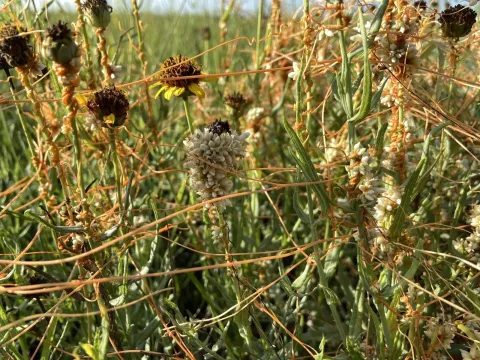
Scaly dodder
Cuscuta squamata
Scaly dodder is not a cultivated crop but a parasitic flowering plant that poses a severe threat to agricultural fields and natural vegetation.
What the section contains
Scaly dodder
The life cycle begins when seeds germinate in the soil, producing a slender, thread-like stem that actively searches for a suitable host plant.
Germination typically occurs in synchronization with the growth of host crops, allowing the parasite to establish itself quickly after the initial emergence.
The seeds of this parasite possess remarkable longevity, capable of surviving in the soil seed bank for several years before finding a host.
Spread is facilitated by contaminated seeds, agricultural machinery, and environmental factors like water movement and wildlife activity.
Botanically classified under the family Convolvulaceae (or Cuscutaceae), this species lacks chlorophyll and roots, making it entirely dependent on host plants.
It thrives in regions with warm climates and moderate humidity, which supports the rapid extension of its twining, yellowish-orange stems.
Successful attachment depends on the presence of diverse plant species that can provide the necessary moisture and nutrients through their vascular systems.
The plant demonstrates high adaptability, allowing it to parasitize a wide range of herbaceous plants and sometimes even woody species.
Optimal environmental conditions include well-lit areas where the parasite can entwine its host and develop its dense, tangled mats.
The primary impact of scaly dodder is the significant reduction in crop vigor, growth, and total yield due to the constant nutrient extraction by the parasite.
By forming physical connections to the host's vascular tissues, it acts as a vector for various plant viruses, worsening the health of the infested fields.
Severe infestations often lead to complete crop failure, resulting in significant economic losses for agricultural producers worldwide.
Management is challenging and requires a combination of strict quarantine regulations, clean seed certification, and physical removal of infected plants.
Chemical control remains difficult because the parasite is often protected by the tissues of the host, necessitating precise and early intervention strategies.