
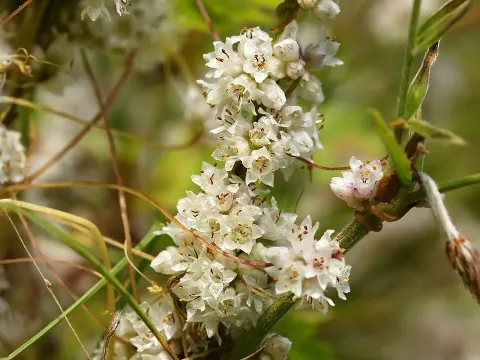
Short-styled dodder
Cuscuta curta
Short-styled dodder (Cuscuta curta) is a specialized parasitic plant belonging to the Convolvulaceae family. It is an obligate parasite, meaning it lacks chlorophyll and cannot photosynthesize, relying entirely on host plants for its nutritional needs.
What the section contains
Short-styled dodder
The plant originates from diverse temperate zones and is commonly found in fields where host plants like clover, alfalfa, or certain vegetables are grown. Its lifecycle is perfectly synchronized with the development of host crops, allowing for rapid infestation.
Regarding ecological requirements, this species thrives in environments where host density is high. The seeds possess a hard coat that allows them to remain viable in the soil for several years, waiting for favorable moisture and temperature conditions to germinate.
Soil quality is not a primary limiting factor for the parasite, as long as it has access to a suitable host. However, it displays increased vigor in warm, humid conditions that support both the dodder's growth and the host's physiological activity.
Agronomic control is primarily focused on prevention. Farmers are advised to source clean, certified seeds, monitor field borders, and implement deep tillage practices to bury seeds too deep for successful emergence.
As a significant agricultural pest, the short-styled dodder causes substantial yield losses. By siphoning nutrients and water, it stunts the growth of host plants and can significantly reduce the nutritional value of forage crops.
The parasitic action often leads to the death of the host plant in severe infestations. This weakens the entire field stand and creates patches of bare ground, which may eventually become susceptible to other invasive weeds.
Crucially, dodder acts as a bridge for plant viruses. It transmits various pathogens from infected plants to healthy ones, acting as a vector that complicates disease management in commercial farms.
Control is challenging because the parasite is biologically linked to the crop. Standard herbicide treatments must be carefully applied to avoid damaging the crop while eliminating the dodder, often requiring targeted spot treatments.
Effective management includes:
- Implementing long-term crop rotation.
- Quarantine of infested equipment.
- Hand weeding before seed production.
- Early harvesting of infested patches.