
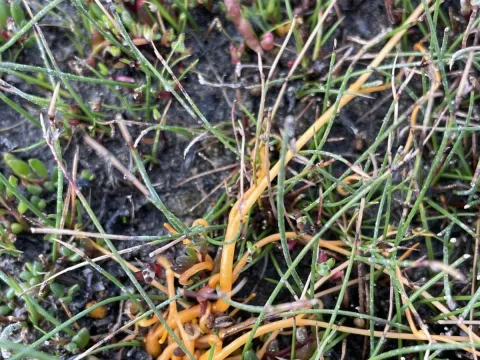
Tasmanian dodder
Cuscuta tasmanica
Tasmanian dodder (Cuscuta tasmanica) belongs to the Convolvulaceae family. It is a specialized parasitic plant that has evolved to survive without roots or chlorophyll, relying entirely on host plants for sustenance.
What the section contains
Tasmanian dodder
The native range of this species is primarily within Australia and Tasmania. It inhabits regions where it can find a variety of host species that provide adequate structural support and nutritional flow for its development.
Its botanical structure consists of slender, leafless stems that twine around the host. The plant develops haustoria—specialized intrusive structures—which penetrate the host tissues to tap into the vascular system.
This species thrives in environments with moderate to high humidity, which is essential for seed germination. It generally establishes itself in areas with dense vegetation, which facilitates the initial attachment to a host.
The plant is categorized as a weed and a significant quarantine pest rather than a crop. It requires no human cultivation; instead, it is a target for strict eradication efforts due to the severe damage it causes to plants.
The primary threat posed by Cuscuta tasmanica is the drain of nutrients from the host plant. By parasitizing crops, the dodder causes stunted growth, reduced yields, and eventually the death of the host organism.
Furthermore, it acts as a vector for various plant viruses. Because its haustoria connect the vascular systems of multiple plants, it efficiently spreads diseases throughout a field, complicating phytosanitary management.
Control measures are primarily preventive. This includes strict inspection of crop seeds to ensure they are free from parasitic weed contamination and the regulation of interstate or international movement of plant materials.
Chemical control is notoriously difficult because the parasite and the host are so closely integrated. Selective herbicides that do not harm the crop but eliminate the dodder are limited and often require precise timing.
Mechanical destruction is the most reliable method for smaller infestations. Heavily infested plants should be removed, collected carefully, and destroyed by burning to ensure that no seeds remain in the field.