
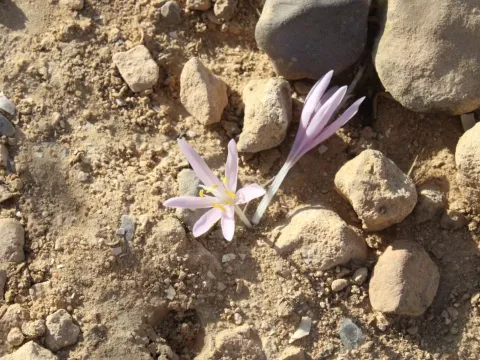
Colchicum tunicatum
Colchicum tunicatum
Colchicum tunicatum is a perennial bulbous plant belonging to the Colchicaceae family. It is native to arid and semi-arid regions of Central Asia, where it thrives in rocky or steppe habitats.
What the section contains
Colchicum tunicatum
The plant demonstrates significant tolerance to drought conditions, making it well-suited for regions with low annual precipitation. However, it requires a full-sun exposure to complete its specific seasonal growth cycle.
Cultivation requires well-drained, sandy or gravelly soils. Providing excellent drainage is the most crucial agronomic factor, as waterlogged conditions during dormancy can rapidly lead to bulb rot.
The botanical structure is unique, featuring specialized tunics (scales) that protect the bulb during extreme heat. The plant exhibits a hysteranthous growth habit, where leaves appear in spring, while flowers emerge in late autumn.
For successful agricultural production, planting should be done at a moderate depth, ensuring that the soil structure allows for proper root development without excessive moisture accumulation.
The primary threats to Colchicum tunicatum populations are fungal infections such as Fusarium wilt, which can devastate bulb health if the soil drainage is inadequate or humidity is too high.
Soil-dwelling pests, specifically wireworms and larvae of various scarab beetles, represent a major risk by mechanically damaging the bulbs, creating entry points for secondary pathogens.
Grey mold (Botrytis) is another potential issue, especially in dense plantings with poor air circulation. Proper spacing is essential to mitigate the risk of fungal spread between individual plants.
Management strategies involve rigorous inspection of bulbs prior to planting and the application of suitable fungicidal treatments to protect against soil-borne diseases.
Integrated pest management (IPM) techniques, including regular soil cultivation and field sanitation, are effective in maintaining the health and productivity of the crop throughout its long lifecycle.