
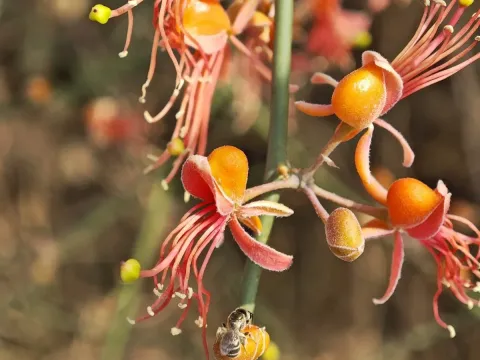
Caper bush
Capparis decidua
The Caper bush (scientifically known as Capparis decidua) is a perennial shrub belonging to the Capparaceae family, native to arid regions of Africa and Asia.
What the section contains
Caper bush
Propagation is typically done via seeds or cuttings. Seeds require mechanical or chemical scarification to break dormancy and ensure uniform germination in a nursery setting.
Sowing should ideally occur in the early spring, ensuring that the soil medium is warm and well-drained to promote rapid root development.
Seedlings remain small during their initial growth stages, requiring careful monitoring to protect them from excessive moisture or competition from weeds.
The plant is known for its deep taproot system, which makes it highly effective at stabilizing soil and accessing groundwater in arid environments.
This species is highly adapted to extreme heat and drought, flourishing in full sunlight where other agricultural crops would fail to survive.
Soil requirements include excellent drainage and tolerance for alkaline or sandy conditions; it is notably resistant to salinity, making it suitable for desert reclamation.
Temperature management is critical; while it handles high heat, prolonged exposure to frost, especially combined with humidity, can severely damage the plant structure.
Watering should be managed with caution, as excessive irrigation during the dormant phase often leads to root rot and fungal complications.
Plant density in agricultural settings should allow for adequate airflow between bushes to maintain plant health and prevent the accumulation of pathogens.
The economic value of the Caper bush lies primarily in its flower buds and immature fruits, which are traditionally harvested and pickled for culinary use.
Productivity is sustainable over several decades, provided that the plant receives periodic pruning to encourage the development of new, high-yielding branches.
Beyond food products, the plant's timber is highly valued in local construction due to its natural resistance against termites and wood-decay fungi.
Fruits are often gathered for their medicinal properties, as they contain unique phytochemicals used in traditional herbal medicine for various conditions.
The annual yield can be optimized by strategic fertilization that balances vegetative growth with the plant's natural reproductive cycle during the peak season.
Fungal infections, particularly root rot, are the most significant threats to the Caper bush, usually triggered by poor drainage or overwatering during cool weather.
Pests, including various leaf-eating insects, can cause defoliation if left uncontrolled, potentially reducing the plant's ability to store energy for the next season.
Rodents may target young seedlings, requiring protective measures such as mesh guards until the plant develops a woody, resistant stem.
Excessive humidity in the atmosphere can predispose the leaves to mildew, emphasizing the need for selecting sites with good natural ventilation.
Agricultural management must prioritize hygiene, ensuring that infected plant material is removed promptly to prevent the spread of localized diseases.
Harvesting is a labor-intensive process, as flower buds must be gathered by hand before they reach the stage of full expansion to maintain premium quality.
Fruits should be harvested only when they reach maturity and the desired stage of softness, as early picking significantly impacts their flavor and texture.
Post-harvest handling requires quick processing or storage in cool, dry conditions to prevent the rapid degradation caused by intense ambient temperatures.
Success in production depends on frequent monitoring, as buds often mature rapidly during the peak of the flowering season, requiring daily visits to the plantation.
Efficient organization of the harvesting labor force is essential for large-scale operations to ensure that all produce is gathered at the optimal stage of development.