
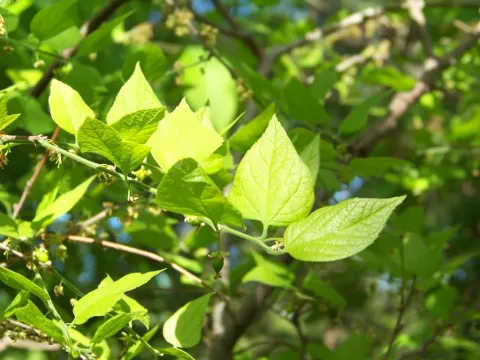
Dwarf hackberry
Celtis tenuifolia
Sowing seeds of Celtis tenuifolia is most effective when done in the autumn, allowing the natural winter cycle to break seed dormancy.
What the section contains
Dwarf hackberry
For spring sowing, seeds must undergo cold stratification in a moist medium at temperatures between 1–5 degrees Celsius for at least two months.
The planting depth for seeds should be kept at 2 to 3 centimeters, using a well-draining soil mix to ensure optimal seedling survival.
Transplanting saplings is recommended during the dormant season, either early in the spring or late in the autumn, to minimize transplant shock.
Proper spacing is crucial for canopy development, so saplings should be planted at least 3 to 4 meters apart in landscape or nursery settings.
The Dwarf hackberry, a member of the Cannabaceae family, is a small tree or shrub noted for its durability and resilience in harsh landscapes.
Native to North America, this species has evolved to thrive in dry, rocky, and semi-arid environments where other woody plants often fail to establish.
It requires full sun exposure to maintain its characteristic compact, spreading shape and to ensure healthy production of its small, berry-like fruits.
The species is highly tolerant of various soil types, particularly calcareous or rocky soils, provided there is adequate drainage throughout the root zone.
While established trees show remarkable drought resistance, young specimens require supplemental irrigation during the first two years of establishment.
Common health issues for Celtis tenuifolia include powdery mildew, which can appear during periods of high humidity and poor air circulation.
Insect pests such as aphids and scale insects are occasionally encountered, particularly when the tree is stressed by suboptimal growing conditions.
Galls caused by tiny insects are common on the leaves of hackberry species, although they rarely cause significant long-term harm to the tree's health.
To prevent disease outbreaks, regular maintenance including the removal of dead wood and debris is essential for maintaining plant vigor.
In cases of severe infestation, integrated pest management practices, including the use of targeted biological controls, are highly recommended.