
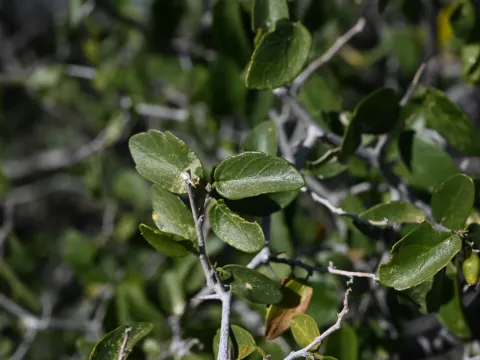
Desert hackberry
Celtis pallida
Celtis pallida, commonly known as the Desert hackberry, is a spiny, evergreen shrub belonging to the Cannabaceae family. It is native to the arid regions of the southwestern United States and Mexico, thriving in extreme environments where few other woody plants can survive.
What the section contains
Desert hackberry
This species requires well-drained, rocky, or sandy soils to flourish. It possesses a remarkable tolerance for high heat and prolonged drought, making it an excellent candidate for xeriscaping and the rehabilitation of degraded ecosystems in hot climates.
Botanically, it is defined by its dense, branching structure armed with sharp thorns, which serve as a survival mechanism against herbivores. The foliage is typically a pale, grayish-green, designed to reflect sunlight and conserve internal moisture during intense heat.
In terms of agricultural and environmental use, the Desert hackberry is valued for erosion control. Its deep, fibrous root system stabilizes loose soil, preventing desertification and maintaining the integrity of the ground surface in fragile environments.
Cultivation success depends on providing full sun exposure. The plant does not require fertilizers in natural settings, and its maintenance needs are minimal, focusing mostly on initial establishment until the root system is sufficiently developed.
The Desert hackberry is inherently resilient and resistant to most common plant diseases. The primary threat to its health is waterlogged soil, which encourages root rot and compromises the plant's structural stability and overall vitality.
Pests are generally not a significant issue for established shrubs. However, young plants may occasionally be affected by aphids or spider mites during periods of high humidity or poor air circulation, which are abnormal for their natural habitat.
Fungal issues, such as powdery mildew, may occur if the plants are placed in overcrowded conditions with insufficient airflow. Proper spacing during planting is the best strategy to mitigate this risk without chemical intervention.
Root rot pathogens represent the most critical threat. Growers should prioritize site selection, ensuring the ground is porous and elevated enough to prevent standing water during rare but heavy rain events.
Managing the plant involves little beyond structural pruning to remove dead wood. By avoiding excessive nitrogen application, one can prevent overly succulent growth that might otherwise attract opportunistic insect pests.