
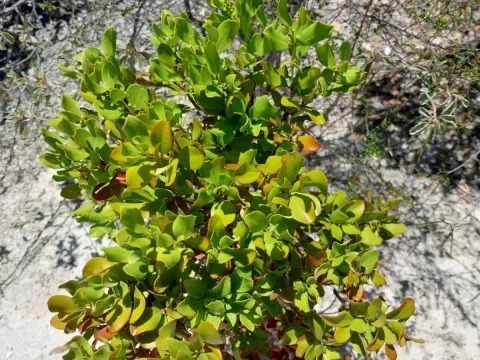
Bahama boxwood
Buxus bahamensis
Bahama boxwood (Buxus bahamensis) is a unique evergreen shrub belonging to the Buxaceae family. Native to the Bahamas and the Turks and Caicos Islands, this species is well-adapted to rocky, limestone-based habitats.
What the section contains
Bahama boxwood
Botanically, it is characterized by its slow growth rate, dense woody structure, and small, leathery, opposite leaves. The foliage maintains a deep green, glossy appearance throughout the year under appropriate environmental conditions.
The plant requires well-draining soil and a pH range that is neutral to slightly alkaline. Unlike many common landscape boxwoods, it is highly sensitive to cold and thrives best in frost-free tropical or subtropical climates.
In terms of light, Buxus bahamensis prefers full sun to partial shade. Proper spacing is essential to ensure adequate air circulation within the canopy, which helps in preventing fungal issues common in dense boxwood structures.
Cultivation is primarily focused on botanical collections, specialized landscaping, and as a specimen plant in container gardening where winter protection can be provided during colder months.
The primary threat to the health of Bahama boxwood is the box tree moth (Cydalima perspectalis), which can cause rapid and severe defoliation if not managed immediately through integrated pest control.
Fungal pathogens such as Volutella buxi represent a constant risk, particularly in high-humidity environments. These pathogens manifest as leaf spots, twig dieback, and pinkish spore masses on affected plant tissues.
Pests like spider mites and scale insects can weaken the plant by feeding on sap, often resulting in yellowing foliage and stunted growth, especially when the plant is kept under stress in restricted container conditions.
Root rot resulting from poor soil drainage is a critical threat. Ensuring a coarse, mineral-rich growing medium is essential to prevent waterlogging and the subsequent proliferation of soil-borne pathogens.
Regular maintenance including sanitation pruning of infected twigs and the application of targeted insecticides or fungicides is necessary to maintain the long-term vigor of this ornamental species.