
LALGARD M52
DANSTAR FERMENT AG, Poststrasse, 30, CH-6300
Insecticides
0
0
1 offer
49.07 €per pack
Buy

Buxus L.
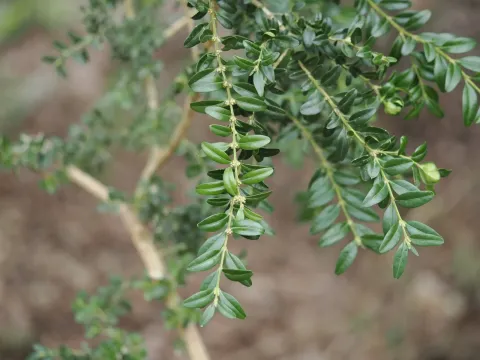
Boxwood (Buxus L.) is a genus of evergreen, slow-growing shrubs and trees belonging to the Buxaceae family. The plant is valued for its dense, leathery foliage and high tolerance to pruning, making it indispensable in topiary art and hedge formation.
 Buxus bodinieri
 H. Lév.
Chinese boxwood
hybrids between Buxus microphylla Siebold & Zucc. var. japonica (Müll. Arg. ex Miq.) Rehder & E. H. Wilson and Buxus sinica (Rehder & E. H. Wilson) M. Cheng
Buxus bodinieri
Buxus bodinieri H. Lév.
Chinese boxwood
hybrids between Buxus microphylla Siebold & Zucc. var. japonica (Müll. Arg. ex Miq.) Rehder & E. H. Wilson and Buxus sinica (Rehder & E. H. Wilson) M. Cheng
 Chinese boxwood
Buxus sinica (Rehder & E. H. Wilson) M. Cheng
Chinese boxwood
Buxus sinica (Rehder & E. H. Wilson) M. Cheng
 Common box
Buxus sempervirens L.
Common box
Buxus sempervirens L.
 Henry boxwood
Buxus henryi Mayr
Henry boxwood
Buxus henryi Mayr x Buxus sempervirens L.
Henry boxwood
Buxus henryi Mayr
Henry boxwood
Buxus henryi Mayr x Buxus sempervirens L.
 Hybrid boxwood
hybrids between Buxus microphylla Siebold & Zucc. and Buxus sempervirens L.
Hybrid boxwood
hybrids between Buxus microphylla Siebold & Zucc. and Buxus sempervirens L.
 Hybrid Boxwood
hybrids between Buxus sempervirens L.and Buxus sinica (Rehder & E. H. Wilson) M. Cheng var. insularis (Nakai) M. Cheng
Hybrid of Buxus bodinieri and Buxus sempervirens
hybrids between Buxus bodinieri H. Lév. and Buxus sempervirens L.
Hybrid Boxwood
hybrids between Buxus sempervirens L.and Buxus sinica (Rehder & E. H. Wilson) M. Cheng var. insularis (Nakai) M. Cheng
Hybrid of Buxus bodinieri and Buxus sempervirens
hybrids between Buxus bodinieri H. Lév. and Buxus sempervirens L.
 Japanese boxwood
Buxus microphylla Siebold & Zucc. var. japonica (Müll. Arg. ex Miq.) Rehder & E. H. Wilson
Japanese boxwood
Buxus microphylla Siebold & Zucc. var. japonica (Müll. Arg. ex Miq.) Rehder & E. H. Wilson
 Korean boxwood
Buxus sinica (Rehder & E. H. Wilson) M. Cheng var. insularis (Nakai) M. Cheng
Littleleaf boxwood
Buxus microphylla Siebold & Zucc.
Korean boxwood
Buxus sinica (Rehder & E. H. Wilson) M. Cheng var. insularis (Nakai) M. Cheng
Littleleaf boxwood
Buxus microphylla Siebold & Zucc.
In its natural habitat, boxwood grows in regions with temperate and subtropical climates across Europe, Asia, and North Africa. The plant prefers moderately moist, fertile soils with a neutral or slightly alkaline pH and does not tolerate waterlogging or acidic substrates.
For successful vegetation, the crop requires a location with good light or partial shade. Direct sunlight in early spring can cause leaf scorch, so young seedlings often need protection during the snow-melt period when the sun becomes active.
Agrotechnology includes regular pruning to create a dense crown. Boxwood has a slow growth rate, so balanced fertilization with nitrogen fertilizers in the first half of the season and potassium-phosphorus fertilizers in late summer is a key element of care.
The economic use of boxwood includes ornamental gardening, park landscaping, and the creation of complex landscape designs. Due to its hard, dense wood, boxwood has historically been used for making musical instruments, carvings, and high-quality engraving blocks.
The main threat to boxwood is the box tree moth (Cydalima perspectalis), an invasive pest whose larvae can destroy a bush in a short time by consuming the leaves and bark.
Fungal diseases such as Volutella blight and Phyllosticta leaf spot are also common, causing twig dieback and leaf spotting.
To prevent the spread of diseases, it is necessary to remove affected branches promptly and perform sanitary pruning to ensure proper crown aeration.
Chemical protection involves the use of contact and systemic insecticides against the moth, as well as copper-based or systemic fungicides to combat fungal infections.
Constant monitoring of the shrub's health is the key factor for the crop's survival, especially in regions with high pest population density.