
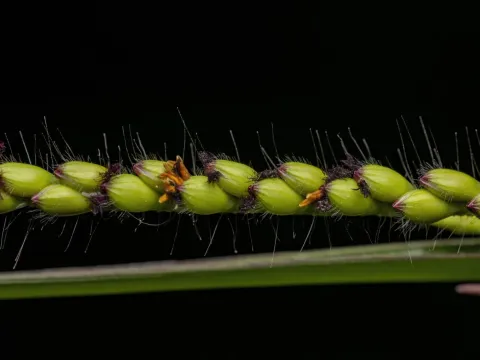
Brachiaria decumbens
Brachiaria decumbens
Sowing Brachiaria decumbens is typically scheduled at the beginning of the rainy season. This ensures that the soil has sufficient moisture levels, which are critical for the successful germination and initial establishment of the crop.
What the section contains
Brachiaria decumbens
The seeds are small, requiring a shallow sowing depth of no more than 1–2 centimeters. Planting too deep can cause the seedling to exhaust its energy reserves before it reaches the surface, leading to poor establishment.
Vegetative propagation using stolons or rooted cuttings is a common and often more reliable method in areas with limited seed availability. This allows for a more rapid ground cover compared to traditional seed-based sowing.
Seed sowing rates range between 3 to 5 kilograms per hectare of viable seeds. A well-prepared, fine seedbed is essential to ensure consistent contact between the seeds and the soil for better emergence results.
The establishment phase is slow, making weed control essential during the first 6 weeks. Once the plant has developed a strong root system and stolons, it becomes highly effective at suppressing competing weeds.
Brachiaria decumbens is a perennial grass belonging to the Poaceae family, native to East Africa. It is widely cultivated in tropical and subtropical regions for its exceptional adaptation to poor soils.
The plant thrives in acid soils with low phosphorus levels and high aluminum content, where many other forage species would fail. It is a preferred crop for reclaiming degraded lands in tropical climates.
Well-drained soil is preferred, as the crop is sensitive to waterlogging. Despite this, it shows remarkable tolerance to intermittent drought, allowing it to maintain productivity throughout the dry season.
Adequate nitrogen fertilization is key to maintaining high biomass yields. While it survives on poor soils, it responds vigorously to nutrients, resulting in improved protein content and faster regrowth cycles.
Its deep root system provides excellent soil stabilization and helps prevent erosion. The plant forms a dense mat of stolons that protects the soil surface from heavy rainfall and high foot traffic from livestock.
Biomass production of Brachiaria decumbens can reach 10–20 tons of dry matter per hectare annually under optimal management. Yields are highly dependent on fertilizer input and precipitation patterns.
The grass is highly resilient and recovers quickly after grazing or mowing. Under a well-managed rotational grazing system, cattle can return to the pasture in about 30 days to ensure continuous forage availability.
Crude protein content typically ranges from 7% to 12% in the dry matter. To ensure the highest quality forage, it is recommended to graze or harvest the grass during its active vegetative growth stage.
If managed without periodic fertilization, the productivity of the pasture tends to decline over time due to nutrient depletion. Regular nitrogen replenishment is necessary for sustained long-term yields.
Over-mature grass becomes stemmy and significantly drops in nutritional value. Therefore, balancing the stocking density is crucial to keep the vegetation in a palatable and nutritious state for livestock.
The most significant threat to Brachiaria decumbens is the spittlebug, an insect that feeds on the plant sap. Infestations lead to severe foliage damage, yellowing, and the eventual death of large sections of the pasture.
Spittlebug nymphs are protected by a frothy mass, which makes traditional contact insecticides less effective. The primary strategy for management is the selection of resistant cultivars bred specifically for this purpose.
Fungal diseases, such as leaf spot or rust, can affect the plant during periods of high humidity and heat. These diseases reduce the photosynthetic surface area and decrease the overall quality of the forage.
Maintaining proper grazing pressure and preventing soil compaction are effective management practices that help the grass stay vigorous and more resistant to pests and pathogens.
In rare instances, the grass can cause photosensitization in young ruminants if not managed correctly. Introducing cattle slowly to new pastures is a recommended practice to ensure animal health.
Rotational grazing is the most common and effective way to utilize this crop. The plant's ability to form a thick, durable mat makes it ideal for handling the physical pressure of grazing livestock.
While primarily used for grazing, the crop can be harvested for hay. However, it requires careful moisture management during drying to prevent mold growth, as the stems are naturally thick and coarse.
Seed harvesting is technically challenging because the spikelets do not mature uniformly. Harvesting is usually performed when the seeds turn dark brown, followed by careful drying in well-ventilated areas.
Silage production is possible when the material is supplemented with fermentation additives. This provides a valuable high-energy food source during winter months or extended dry seasons.
When cutting for hay or silage, it is vital to leave a stubble height of at least 10–15 centimeters. This ensures that the plant has enough energy to regenerate quickly and maintain its long-term viability.