
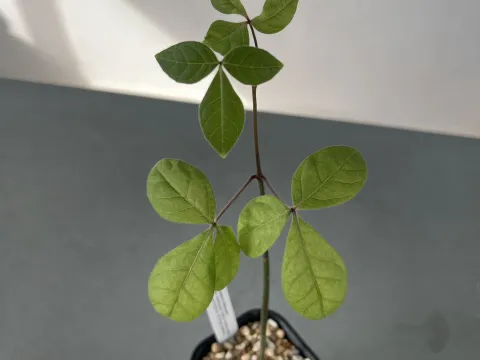
Commiphora mildbraedii
Commiphora mildbraedii
Commiphora mildbraedii is a distinctive woody plant belonging to the Burseraceae family, native to arid African regions. It has evolved to thrive in harsh environments, characterized by long dry spells and intense solar radiation.
What the section contains
Commiphora mildbraedii
When cultivating this species, soil selection is paramount. The plant requires excellent aeration and rapid drainage, as it is highly susceptible to root rot if water lingers around the root ball. Rocky or sandy loam soils are ideal.
Climatic requirements involve maintaining consistently warm temperatures, ideally between 22 and 32 degrees Celsius. It possesses no frost tolerance, making it strictly a plant for arid tropical or controlled greenhouse environments.
Watering protocols must be strictly managed. During the active growth phase, moisture should be provided in moderation, allowing the soil to dry out almost completely between irrigation cycles to prevent anaerobic conditions.
Propagation is typically performed through stem cuttings or seeds. Cuttings require a sterile, sandy medium and high warmth to initiate root development. Successful establishment takes time due to the plant's slow growth habit.
The primary agricultural objective for Commiphora mildbraedii is the harvesting of resinous exudates. This process, often referred to as tapping, involves creating minor, controlled incisions in the bark to stimulate the flow of sap.
Harvesting timing is critical and usually coincides with the dry season, which facilitates the solidification of the resin and increases the concentration of desirable aromatic compounds. Careful extraction ensures the health of the tree is maintained.
Post-harvest processing involves cleaning the resin to remove bark fragments and other debris. High-quality resin is highly valued in pharmaceutical and fragrance industries for its unique chemical properties.
Beyond resin production, the plant serves as a biological model for studying drought resistance and secondary metabolism in trees. In some botanical collections, it is also maintained for its aesthetic, sculptural form.
Proper management of the plantation includes monitoring for sap-feeding insects that may target the sites of resin collection. Regular health checks of the bark are essential to ensure the longevity of the plant and consistent yields.