
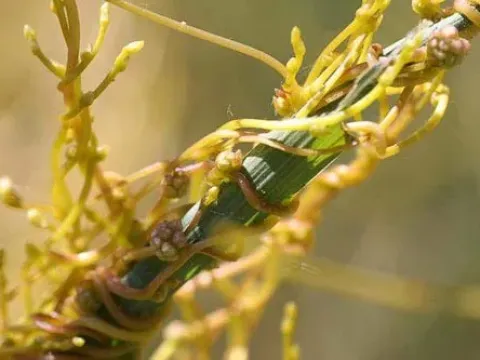
Burell's dodder
Cuscuta burellii
Burell's dodder (Latin Cuscuta burellii) is a parasitic plant belonging to the Convolvulaceae family. It is classified not as a crop, but as a dangerous quarantine weed that poses a significant threat to global agriculture and local biodiversity.
What the section contains
Burell's dodder
The plant is an obligate parasite, meaning it lacks both roots and chlorophyll throughout its entire life cycle. It relies entirely on its host for nutrition, water, and minerals, which it extracts by inserting special organs called haustoria into the host's stems.
It is found primarily in temperate and warm climates, adapting to a wide range of herbaceous host plants. The plant prefers habitats with high humidity and sunlight, which support the rapid growth of its slender, golden-colored stems that entwine the host.
Soil requirements for Burell's dodder are largely irrelevant because it does not maintain a root system. However, healthy and vigorous host plants in fertile soil provide a more stable energy source, which often results in more severe infestations.
Agricultural management is strictly preventative. Techniques include the use of weed-free certified seeds, cleaning farming machinery between fields, and crop rotation to interrupt the parasite's host supply cycle in infested areas.
The primary threat of Burell's dodder is the physical depletion of host plants. By diverting water and nutrients intended for crop growth, the parasite significantly reduces overall yields and can cause the total collapse of the crop in heavily infested fields.
Dodder is also a notorious carrier of plant viruses and phytoplasmas. Once attached to a host, it serves as a bridge, allowing pathogens to transmit rapidly between plants and potentially creating uncontrollable disease outbreaks across an entire farm.
Natural enemies of dodder, such as specific insects or fungi, are currently limited in their effectiveness. Research into biological control is ongoing, but mechanical removal and chemical suppression remain the standard practice for farmers.
Harvesting becomes problematic in infested fields, as the sticky, vine-like structure of the dodder entangles with harvesting machinery, causing equipment malfunctions and contaminating the final product with its tiny, resilient seeds.
Effective control requires early identification. Any detection of dodder should result in the immediate destruction of the affected area and a period of intensive observation to ensure no seeds remain in the soil bank for subsequent seasons.