
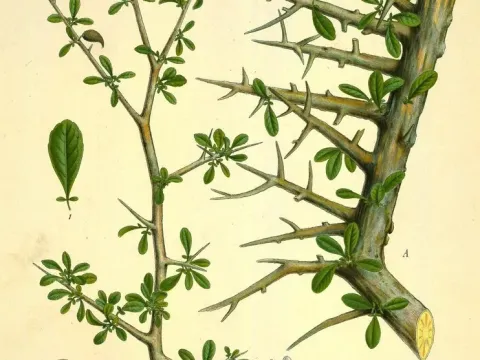
Commiphora myrrha
Commiphora myrrha
Propagating Commiphora myrrha in an agricultural setting is typically achieved through seeds or stem cuttings in specialized nursery environments.
What the section contains
Commiphora myrrha
Seeds require a well-draining, sandy substrate and consistent temperatures above 25 degrees Celsius to ensure successful germination and seedling survival.
Stem cuttings are often preferred for plantation management as they ensure genetic uniformity and significantly reduce the time needed to produce a mature tree.
Young plants must undergo a rigorous acclimatization phase in a protected environment to strengthen their root systems before field transplantation.
Excessive moisture during the sowing phase is the primary cause of failure, as both seeds and seedlings are highly susceptible to damp-off pathogens.
Commiphora myrrha, a member of the Burseraceae family, is a drought-tolerant, thorny shrub or small tree native to arid, rocky landscapes.
The culture thrives in tropical environments and has zero tolerance for freezing temperatures, which restricts its cultivation to arid, hot regions.
Soil requirements are minimal regarding fertility, but perfect drainage is non-negotiable to prevent root rot in these sensitive, arid-adapted species.
High levels of solar radiation are essential for the plant's metabolic processes and the subsequent development of its unique chemical compounds.
Minimal water input is required, making the plant an excellent candidate for semi-desert farming where other water-intensive crops fail.
The primary agricultural objective of Commiphora myrrha is the production of myrrh, an aromatic resin widely used in the pharmaceutical and fragrance industries.
Yields are determined by the tree's maturity, the environmental stress factors, and the precision of the tapping techniques applied to the trunk.
Trees must reach a specific age before harvesting can safely begin, ensuring that the plant has sufficient biomass to withstand the extraction process.
Yield variability is common, as environmental stressors often trigger the tree to produce more resin as a natural defense mechanism against drought.
Quality control during post-harvest processing is critical to ensure the resin remains free of debris and meets high international market standards.
Fungal pathogens associated with high soil moisture and poor airflow pose the greatest risk to the health and longevity of Commiphora plantations.
Boring insects, including various wood-boring beetles, can compromise tree integrity by entering through harvesting incisions or natural bark cracks.
Improper tapping techniques can lead to secondary infections, causing necrosis of the branches and significantly reducing the tree's productive lifespan.
Maintaining a healthy, dry environment is the most effective preventative measure against the spread of pests and disease in a commercial grove.
Periodic inspection of the canopy and trunk is necessary to identify localized infestations before they spread across the entire agricultural site.
The harvest process involves carefully making superficial incisions in the bark to trigger the secretion of the tree's aromatic resin.
The resin exudes as a milky liquid which, upon contact with the air, gradually solidifies into hard, yellow-to-brown lumps of varying sizes.
Hand-harvesting of the solidified resin is performed several weeks after the initial tapping, requiring manual labor to collect the valuable product.
Harvesting frequency must be strictly managed to avoid exhausting the plant, allowing it adequate recovery periods between tapping cycles.
After collection, the raw resin undergoes rigorous cleaning and grading to remove natural impurities and classify it based on aromatic intensity.