
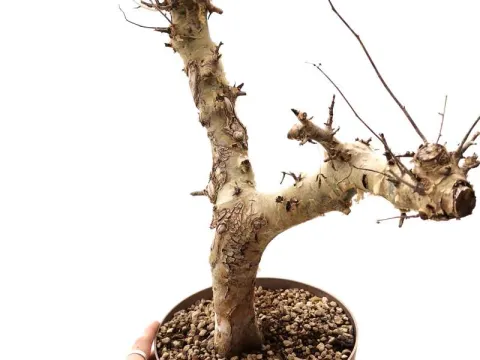
Commiphora kataf
Commiphora kataf
Propagation of Commiphora kataf is primarily achieved through seeds or stem cuttings, requiring specific handling to ensure successful establishment.
What the section contains
Commiphora kataf
Seeds must be sown in a well-draining, sandy-based substrate to replicate their natural arid environment and prevent moisture-related issues.
Germination is most effective at temperatures between 25 and 30 degrees Celsius, which encourages the seeds to sprout within a few weeks.
For vegetative propagation, semi-hardwood cuttings are utilized, treated with rooting hormones to enhance the development of a robust root system.
It is critical to maintain low humidity levels for young plants to avoid damping-off, a common fungal issue for seedlings in this genus.
Commiphora kataf belongs to the Burseraceae family and is native to the dry woodlands and shrublands of the Horn of Africa and the Arabian Peninsula.
The species thrives in full sun, requiring high levels of solar radiation to produce the specialized compounds found within its resin canals.
Soil requirements include excellent drainage and low nutritional content; gravelly or sandy soils are ideal for preventing root rot.
As a drought-tolerant crop, it requires very little irrigation once established, though moderate water supply is beneficial during early development.
The plant is sensitive to frost and high humidity, making it suitable mainly for tropical or subtropical climates, or controlled greenhouse conditions.
The primary yield from Commiphora kataf is its fragrant gum-resin, which is highly valued for its use in the perfume and pharmaceutical sectors.
Yield capacity improves as the tree matures, with substantial resin production typically beginning after several years of consistent growth.
Resin is obtained through a process known as tapping, where light incisions are made into the bark, allowing the sap to exude and solidify.
Yield efficiency is highly dependent on the tree's health, environmental conditions, and the precision of the harvesting technique employed.
Sustainable harvesting practices, such as rotating harvest sites, are essential to maintain tree longevity and long-term production levels.
Root rot caused by waterlogged soil or poor drainage is the single most significant threat to the survival of Commiphora kataf plantations.
Pests such as spider mites and mealybugs can infest the foliage, particularly in confined environments where airflow is insufficient.
Fungal infections can enter the plant through unprotected bark wounds, leading to tissue necrosis and reduced resin yield.
Poor site selection, especially areas prone to high moisture, leads to immediate decline in plant vigor and increased susceptibility to pathogens.
- Ensuring optimal drainage in all planting sites.
- Regular monitoring for signs of scale insects or spider mites.
- Using clean tools for any necessary pruning or tapping.
Harvesting of the resin is a manual process performed during the dry season when the trees naturally enter a period of lower activity.
Incisions are carefully made on the trunk, avoiding damage to the cambium layer to ensure the tree remains healthy and capable of future growth.
The solidified resin is collected after a period of drying on the bark, ensuring the product is free from contaminants like dirt or moisture.
Grading the resin based on color, clarity, and fragrance quality is a standard post-harvest practice to maximize market value.
Professional harvesters emphasize the importance of rest periods for the trees, allowing them to recover after the intense season of resin extraction.