
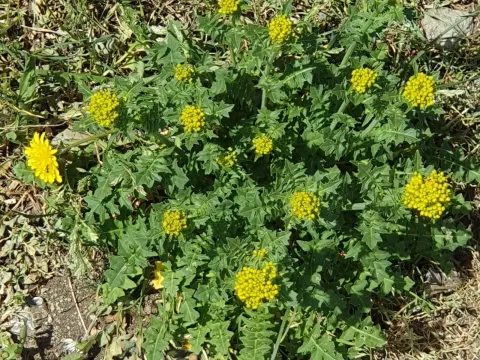
Austrian hedge mustard
Sisymbrium austriacum
Austrian hedge mustard (Sisymbrium austriacum) is a herbaceous member of the Brassicaceae family. It typically appears as a biennial or perennial plant, recognized for its adaptability to rocky substrates and disturbed landscapes across the European continent.
What the section contains
Austrian hedge mustard
The species prefers calcareous soils with good drainage and exposure to full sunlight. It is natively distributed across temperate regions where it thrives in open areas, roadsides, and sparsely vegetated rocky terrains.
Climatically, the plant is hardy and shows significant drought tolerance once established. Its deep taproot system is a biological adaptation that allows it to access deeper soil moisture in regions with irregular precipitation patterns.
In terms of agricultural management, soil structure is crucial. While it can survive in nutrient-poor soils, productivity increases significantly when basic mineral nutrition is provided in light, well-aerated substrates.
Crop maintenance involves regular monitoring of seedling emergence. Although hardy, the plant is susceptible to competition from fast-growing weeds during the initial rosette formation stage, requiring mechanical weeding to prevent biomass loss.
The most significant pests affecting this plant are flea beetles (Alticini), which frequently target the leaves and stems, leaving characteristic shot-holes that impede photosynthesis.
Fungal pathogens such as downy mildew are common threats, especially when cultivation occurs in environments with poor air circulation or extended periods of high humidity.
Aphids are a major concern, as they colonize the floral racemes, extracting nutrients and transmitting viruses that can lead to systemic plant decline.
The control of diseases is best achieved through integrated pest management (IPM) practices, including the use of resistant varieties where available and periodic inspection for early infection signs.
Crop rotation remains the primary preventative measure; avoiding successive planting of Brassicaceae on the same field helps prevent the buildup of soil-borne pathogens and pests specific to the mustard family.