
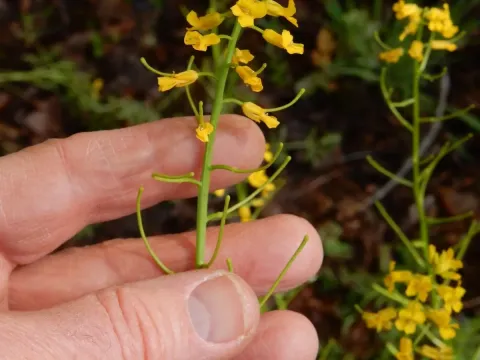
Barbarea orthoceras
Barbarea orthoceras
Barbarea orthoceras, commonly known as American yellowrocket, is a biennial plant belonging to the Brassicaceae family. It is typically found in moist, temperate habitats and is valued for its hardiness and ability to thrive in cool environments with short growing seasons.
What the section contains
Barbarea orthoceras
For agricultural purposes, seeds should be sown in early spring or late autumn to allow for proper vernalization. The seeds require shallow planting, ideally at a depth of 1-2 centimeters, to ensure adequate light exposure for germination and to prevent premature exhaustion of energy reserves.
Proper spacing is essential for high biomass production. When cultivating for forage, rows should be spaced 20-30 centimeters apart to reduce inter-plant competition and facilitate weed control operations during the vegetative stage.
The plant exhibits high seed viability, which can lead to self-seeding in following years if the harvest is not timed correctly. Farmers should manage the flowering phase carefully to control the population density on their fields.
Soil preparation should involve thorough plowing and leveling to create a fine seedbed. Compaction should be avoided, as the species performs best in loose, well-aerated soils where the taproot can penetrate deeply to access moisture.
This species is highly adapted to wet conditions and is frequently observed along riverbanks and in damp meadow ecosystems. It demands constant soil moisture, making it an excellent candidate for regions with high water tables or consistent precipitation.
Temperature tolerance is a hallmark of Barbarea orthoceras, as it can withstand freezing temperatures that would be lethal to many other agricultural crops. It thrives in temperate to subarctic climates where cold stress is a limiting factor for development.
In terms of light, the plant prefers full sun to partial shade. While it can tolerate some cover, maximum yield of forage is achieved in areas with at least 6-8 hours of direct sunlight per day, which accelerates the development of the primary rosette.
Soil acidity should be kept in the near-neutral range. Extremely alkaline or acidic soils inhibit nutrient uptake, particularly micro-elements essential for the synthesis of protective compounds within the plant tissues.
Nutrient management is straightforward, as the plant responds well to standard nitrogen applications. However, excessive fertilization should be avoided to prevent the development of overly succulent tissues that may become more susceptible to frost or mechanical damage.
The primary pests affecting this crop include various species of flea beetles that target young seedlings. These insects can cause significant damage by perforating the leaves, potentially stunting growth and reducing the overall stand density.
Cabbage moths and other larvae of Lepidoptera are also common threats, as they feed on the foliage throughout the growing season. Integrated pest management, including the use of pheromone traps or biological insecticides, is recommended for sustainable production.
Disease management focuses on preventing fungal infections such as white rust and downy mildew. These pathogens flourish in warm, humid conditions with stagnant air, making proper ventilation through row spacing a vital preventive measure.
Crop rotation is critical when growing Brassicaceae species to break the life cycles of soil-borne pathogens. A minimum 3-year interval between similar crops is recommended to maintain soil health and minimize pressure from weeds and pests.
- Flea beetles
- Cabbage moths
- White rust
- Downy mildew