
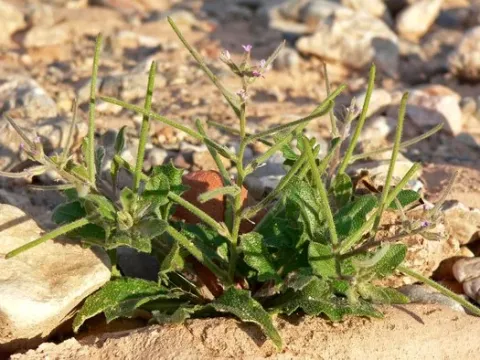
African malcolmia
Malcolmia africana
African malcolmia is an annual herbaceous plant whose life cycle begins with early spring seed germination. In agricultural fields, germination typically occurs when topsoil temperatures reach 5–8 degrees Celsius.
What the section contains
African malcolmia
The flowering period of the crop falls in May–June, making it a significant component of spring agroecosystems. The formation of seed pods occurs quickly, ensuring a rapid accumulation of seeds in the soil seed bank.
In regions with mild climates, seeds can germinate even at slightly positive temperatures, allowing the plant to infest winter crop fields. Agronomic control strategies include mechanical tillage before mass emergence.
The depth of seed burial during natural spreading is shallow, so provocative cultivation helps to quickly clear fields of this object. Crop rotation is recommended to reduce anthropogenic pressure.
The biological traits of the plant allow it to complete its life cycle rapidly, which must be considered when planning herbicide application timelines for cereal crops.
The plant belongs to the Brassicaceae family and is characterized by high ecological plasticity. It can grow on various soil types, including loams, sandy loams, and even saline soils in arid zones.
African malcolmia prefers well-lit areas as it is a light-demanding plant. Under shading by agricultural crops, its development slows down, although it retains the ability to produce seeds.
The crop possesses high drought resistance, allowing it to compete successfully with agricultural crops in conditions of limited moisture. This makes it a difficult-to-eradicate object in steppe zones.
The optimal pH level for active growth ranges from neutral to slightly alkaline. In fertile soil conditions, the plant shows strong growth potential, forming branched shoots with numerous pods.
An important survival factor is a developed root system, which enables the plant to absorb moisture from lower soil horizons during prolonged periods without rainfall.
As a representative of the Brassicaceae family, African malcolmia is susceptible to typical diseases of this family. These include clubroot, downy mildew, and various bacterial infections under excessive moisture.
Pests that parasitize cultivated brassicas can also move to African malcolmia. The primary threat is posed by flea beetles, which destroy young seedlings at the beginning of the growing season.
Mustard beetles and other pests can use this plant as an intermediate host during periods when the main commercial crop is not present in the field. This complicates phytosanitary control.
Aphids often colonize inflorescences, sucking juices and reducing seed viability. Damaged plants become more susceptible to secondary infections and fungal diseases.
To minimize the risks of pathogen spread, chemical control methods are recommended during periods of high pest accumulation on weed vegetation.