
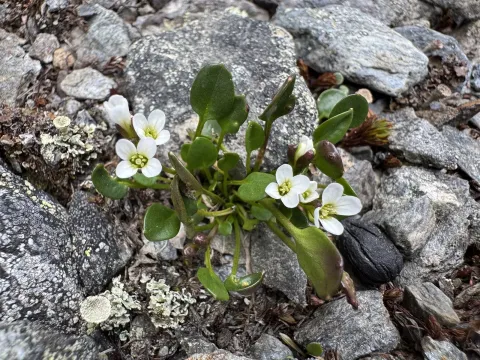
Alpine bittercress
Cardamine bellidifolia
Alpine bittercress (Cardamine bellidifolia) is a small perennial herbaceous plant belonging to the Brassicaceae family. It is distinguished by its compact growth habit, forming a basal rosette of simple leaves and producing tiny white flowers, which are typical adaptations for cold-climate survival.
What the section contains
Alpine bittercress
The native distribution of this species covers a wide range of Arctic and sub-Arctic regions in the Northern Hemisphere, as well as high-mountain ranges across Europe and Asia. Its presence is primarily determined by the availability of rocky terrain and low-competition environments.
Regarding its habitat requirements, the species favors wet, stony, or gravelly substrates, often found along stream beds, on rocky slopes, or in sandy tundra soils. It thrives in environments where thermal regulation and drainage are provided by the geological structure of the soil itself.
In terms of cultivation and management, Alpine bittercress is considered a specialized species. It is rarely grown as a food crop, but it is highly valued by rock garden enthusiasts who seek to recreate high-altitude ecosystems. Successful growth requires consistent soil moisture and protection from extreme summer heat.
Economic and agricultural utility is limited compared to common Brassicaceae relatives like mustard or cabbage. However, the study of its extreme cold-hardiness provides valuable data for agricultural research, focusing on genetic traits that could enhance the resilience of future food crops in changing climates.